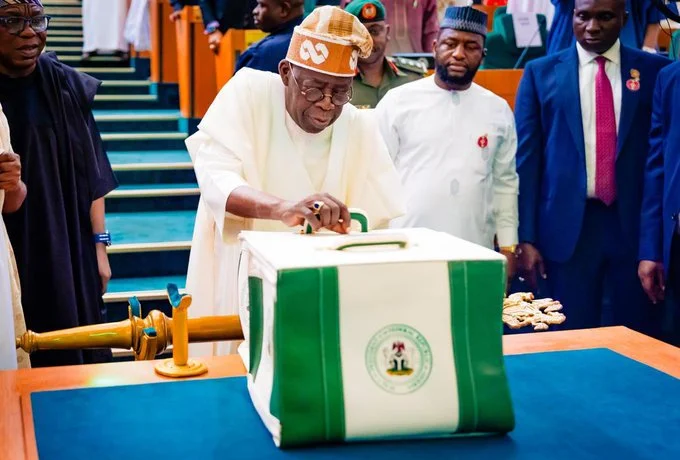
When President Bola Ahmed Tinubu announced in December 2025 that Nigeria would stop operating multiple budgets reliant on the same revenue streams, it seemed like an effort to resolve one of the nation’s most persistent fiscal hurdles.
“We are terminating the habit of running three budgets in one inflow,” Tinubu said while presenting the 2026 Appropriation Bill.
“By March 31, 2026, all capital liabilities from previous years will be fully funded and closed. From April, Nigeria will operate on a single budget backed by a single revenue cycle-no overlaps, no excuses, no rollovers.”
Nine months later, that timetable has been overtaken by events.
On September 30, 2026, the President assented to the Appropriation (Amendment) (No.4) Bill, 2025, extending the implementation of the 2025 budget from September 30 to December 31, 2026.
The Presidency said the extension would give Ministries, Departments and Agencies more time to complete ongoing capital projects and ensure that funds already appropriated were fully utilised.
The explanation addresses the immediate reason for the extension, but it also exposes the difficulty of reconciling the latest decision with the fiscal reset announced by the President less than a year ago.
The 2025 budget is now set to remain operational until the end of December 2026.
The implications of this is that the appropriation will run well beyond the March 31 deadline Tinubu had set for closing previous-year capital liabilities and the April 2026 date he had identified for the beginning of a single budget and revenue cycle.
The latest extension is also not the first adjustment to the 2025 budget timeline.
Earlier in 2026, the implementation period of the capital component of the 2025 Appropriation Act was extended beyond its original deadline, with the government citing the need to complete critical infrastructure and ongoing projects.
The development is significant.
The administration had itself identified overlapping appropriations as a problem requiring an exceptional fiscal reset.
In his December 2025 budget speech, Tinubu said multiple budgets, abandoned projects, inherited obligations and perpetual rollovers had undermined governance and economic planning.
His proposed solution was not merely to improve the execution of existing budgets but to terminate the practice altogether.
But Nigeria’s struggle with budget-cycle discipline predates the Tinubu administration.
The problem has stretched across successive civilian administrations since 1999, although its form and severity have varied.
Under former President Olusegun Obasanjo, the government introduced major public financial management reforms, including the Medium-Term Expenditure Framework, in an effort to improve fiscal planning and reduce the vulnerability of annual budgets to fluctuations in oil revenue.
Yet the transition to a predictable annual budget cycle remained difficult.
Under the late President Umaru Musa Yar’Adua, the 2008 budget was not enacted until April 14, while the 2009 and 2010 budgets were signed in March and April respectively.
The delays continued under President Goodluck Jonathan.
The 2011 budget was enacted on May 27, 2011; the 2012 budget on April 13, 2012; the 2013 appropriation on February 26, 2013; the 2014 budget on May 24; and the 2015 budget on May 19.
The result was that significant portions of several fiscal years elapsed before new appropriations became law.
The delays were often accompanied by disputes between the Executive and the National Assembly over who was responsible.
In 2019, then Speaker of the House of Representatives, Yakubu Dogara, blamed late submission of budget proposals by the Executive for delays under the Buhari administration.
The then Senate President, Bukola Saraki, had earlier pointed to delays by Ministries, Departments and Agencies in defending their budget proposals.
The World Bank subsequently found that federal budgets were enacted an average of five months late between 2015 and 2019, reflecting a wider pattern of weak budget predictability.
There was, however, a significant improvement from 2020.
The 2020 budget was enacted before the start of the fiscal year, while the 2021 budget was signed on December 31, 2020.
The Buhari administration described the development as a return to the January-to-December budget cycle.
But even that improvement was not absolute.
The COVID-19 pandemic disrupted the implementation of the 2020 budget, prompting the Federal Government to extend its capital component into 2021.
The government cited the lockdown, procurement delays and difficulties faced by MDAs in implementing projects.
That history is important.
It shows that Nigeria’s budget problem has never been solely about the absence of political promises.
Successive administrations have attempted reforms, but the system has repeatedly been pulled back by delays in preparation and passage, revenue shortfalls, procurement challenges, project-readiness problems and weak implementation capacity.
The Tinubu administration inherited that complicated history but made ending overlapping budgets one of its more explicit fiscal commitments.
By 2024 and 2025, the government was again operating with overlapping appropriations and extensions.
It was against that background that Tinubu made his December 2025 declaration that the era of “three budgets in one inflow” would end.
The President’s statement raised expectations that 2026 would mark a decisive break with the previous pattern.
Instead, the government has now extended the 2025 budget to the end of the year.
For economists and financial analysts, the concern goes beyond whether such an extension is legally permissible.
Dr Muda Yusuf, Chief Executive Officer of the Centre for the Promotion of Private Enterprise, has repeatedly linked Nigeria’s budget implementation difficulties to the credibility of its revenue and expenditure projections.
Yusuf has warned that repeated budget rollovers create uncertainty because businesses and contractors cannot reliably determine when government-funded projects will actually receive funding.
He has also identified the gap between government projections and actual revenue performance as a fundamental challenge to budget credibility.
Other analysts have raised concerns about the administrative consequences of running overlapping appropriations.
Dr Muhammad-Bashir Yusuf, an economist at Al-Hikmah University, Ilọrin explained to Daily Trust in a telephone chat on Friday that the January-to-December fiscal cycle was important because it provided a definite starting and ending point for government planning, spending and economic measurement.
According to him, a budget essentially sets out how the government intends to raise and spend money within a given period, adding that the proposals remain subject to the availability of funds.
Consequently, he said their implementation depends on the government’s capacity to finance them.
He, however, cautioned against abruptly truncating the current overlapping budget arrangement in an attempt to restore the January-to-December cycle, saying such a move could disrupt projects and other programmes already captured in existing appropriations.
“The fact still remains that it is not difficult to achieve it. We can do that by the act. Just say, okay, we truncate all other budgets and we’ll be starting from January to December,” he said.
But he noted that such an approach would mean sacrificing developments already captured in the existing budget, particularly if the government simply cancelled an entire fiscal year to create room for a fresh January-to-December cycle.
Using the current situation as an example, he said the extension of the 2025 budget into 2026 meant that simply starting another full budget cycle in January 2027 would create another gap that would have to be resolved.
“Except to say we want to cancel the fiscal year, so there won’t be any budget for 2026, then we now start with 2027. That is the easiest way to return it back from January to December,” he said.
He argued that the more practical approach was to recognise that the overlapping cycle did not begin with the present administration and should therefore be addressed through a transition that would not undermine projects already approved and awaiting implementation.
“Whatever is not feasible, we should have known by now,” he said, stressing that it would be unrealistic to expect a government to compress a full year’s budget implementation into only a few months.
He also dismissed the idea of simply transferring an entire year’s budget into the following year and renaming it, saying such an approach would leave unresolved questions about the fiscal year that had effectively been cancelled.
According to him, restoring the January-to-December cycle would nevertheless remain important because economic indicators such as the Gross Domestic Product (GDP) are measured against defined periods.
“We should find a way of normalising it, and this is very important.
“When we talk about our GDP, we talk about a particular year, not over a period of more than a year. So it’s also not good for us”, he said.
The Federal Government, however, has maintained that extensions are designed to protect public funds already appropriated and prevent projects from being abandoned simply because the implementation deadline has expired.
That argument has particular force where projects have already commenced and the government has made financial commitments to contractors.
The September 30 statement from the Presidency was explicit on that point, saying the latest extension would ensure that funds already appropriated were fully put to work without disrupting critical programmes.
The latest decision is therefore not necessarily evidence that the government has abandoned its objective of a predictable budget cycle.
But it does mean that the specific timetable announced by Tinubu in December 2025 has not been achieved.
The President had promised that previous capital liabilities would be closed by March 31 and that from April Nigeria would operate on a single budget backed by a single revenue cycle.
Instead, an earlier budget remains alive until December.
The episode consequently illustrates the tension at the heart of Nigeria’s public finance system.
For more than two decades, successive administrations have confronted versions of the same problem.
The latest extension suggests that the problem remains unresolved.
The December 31, 2026 deadline has therefore become more than another administrative date. It will test whether the government’s promise of a single budget and revenue cycle can finally move from policy declaration to sustained practice.
What You Should Know
Nigeria has historically struggled with budget-cycle delays and overlapping financial years across multiple administrations, which often hinder timely project execution and proper economic planning.
- Positive Impact: Clearer budget timelines and extended completion periods help Ministries, Departments, and Agencies finish crucial capital infrastructure projects rather than leaving them abandoned.
- Potential Concerns: Continued budget extensions and delayed implementation cycles create fiscal unpredictability, complicating economic forecasts for businesses and private sector stakeholders.