
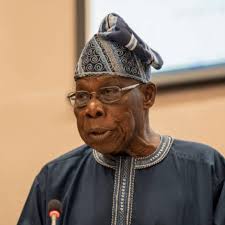
Former President Olusegun Obasanjo cautioned Nigeria on Friday against blindly implementing economic policies handed down by foreign-trained experts without taking the nation’s actual circumstances into account.
Obasanjo spoke in Abeokuta, Ogun State, at the Ajibosin Platform, a public forum themed: “Leveraging Artificial Intelligence to solve grassroots problems and accelerate National Development.”
The former President expressed worry that Nigeria relies on young and unmarried boys and girls who have never managed a household for an economic advice.
He further criticised Nigeria’s dependence on foreign institutions, particularly the World Bank and International Monetary Fund (IMF), arguing that their policies were not necessarily designed to address the country’s peculiar circumstances.
He recalled how Nigeria was discouraged from subsidising agriculture despite what he described as the agricultural support available to farmers in developed countries.
“World Bank and IMF were not designed for us. They were not built by us. They were built before we became independent. And that’s the people who would determine what we do,” he said.
Speaking on the foreign-trained experts, Obasanjo said: “They are brilliant boys and girls, so they went to Ivy League universities, Oxford, Cambridge, and all that.
“These brilliant boys, then they put it, it’s good academically. And they tell us, and we take it, lock, stock and barrel, and we use it.”
He questioned why a country with a population of about 250 million people would depend on the recommendations of young experts who, according to him, might have little experience managing households or understanding the country’s complexities.
“For a country of 250 million people, it is boys and girls who are not even married, let alone manage a home, who will tell us how, what will we do to manage our country? And we swallow it. And we destroy ourselves,” he said.
On the role of Artificial Intelligence in Nigeria’s development, Obasanjo urged the country to approach the technology from the standpoint of its own interests rather than accepting everything presented by foreign powers.
He recalled the historical experiences of slave trade, colonialism, globalisation and structural adjustment programmes, arguing that initiatives introduced to Africa as opportunities had often come with disadvantages.
According to him, Nigeria must take ownership of artificial intelligence and deploy it to address pressing national challenges.
“Can AI help us? We have 24 million Nigerian children that should be in school that are not in school. And if you are looking for disasters of tomorrow, they are the disasters of tomorrow,” he said.
He also identified agriculture, food security, healthcare delivery and pharmaceutical production as areas where artificial intelligence could make significant contributions.
“Can AI help us to know the type of fruit, food that we should, crop that we should produce and produce them adequately, quantitatively, so that we can have food and nutrition security?” he asked.
In his address, the Guest speaker and Convener League of Northern Democrats, Dr Umar Ardo, warned that Artificial Intelligence could become Africa’s new form of extraction, describing unchecked data harvesting as “the slave ship, refitted as the server farm.”
Ardo said history shows Africa has moved from exporting human beings during the transatlantic slave trade, to raw materials under colonialism, and to crude commodities and skilled labour after independence, warning that data may become the fourth commodity.
He argued that Africa generates abundant data through its young population, languages, farms, hospitals and businesses, yet has almost zero hardware and model-building capacity, while its data is collected by platforms it does not own, stored outside its borders and monetized abroad.
“Too often, value flows outward, as it has for centuries. We are told this is ‘leveraging AI for development’. But plainly speaking, without safeguards, this is not leveraging. It is the slave ship, refitted as the server farm,” Ardo said.
The historian, however, said he was not dismissing AI, noting it can help agricultural extension workers detect crop diseases, support primary healthcare where doctors are scarce, improve land records and revenue collection, and help traditional institutions like Owu Kingdom preserve oral traditions and connect artisans to wider markets.
He called for a guarded embrace of AI, urging Nigeria to move beyond the Nigeria Data Protection Act 2023 to true data sovereignty, build local computing infrastructure, own African datasets, direct AI to grassroots governance, and work through the African Union’s Data Policy Framework to ensure Africa becomes an owner, not just a quarry, in the intelligence age.
What You Should Know
Former President Olusegun Obasanjo has raised serious concerns about Nigeria’s heavy reliance on international institutions like the World Bank and the IMF, as well as young, foreign-trained experts who may not understand the grassroots realities of managing a home or a country of 250 million people. Speaking at a public forum in Ogun State, he also urged the nation to take a cautious and self-reliant approach toward emerging technologies like Artificial Intelligence rather than blindly accepting foreign models.
- Positive Impact: Encourages local innovation, data sovereignty, and home-grown economic strategies tailored to solving Nigeria’s peculiar domestic challenges.
- Potential Concerns: Highlights the risk of worsening national hardship if inappropriate foreign economic policies and unchecked external data harvesting continue to be adopted without local safeguards.