
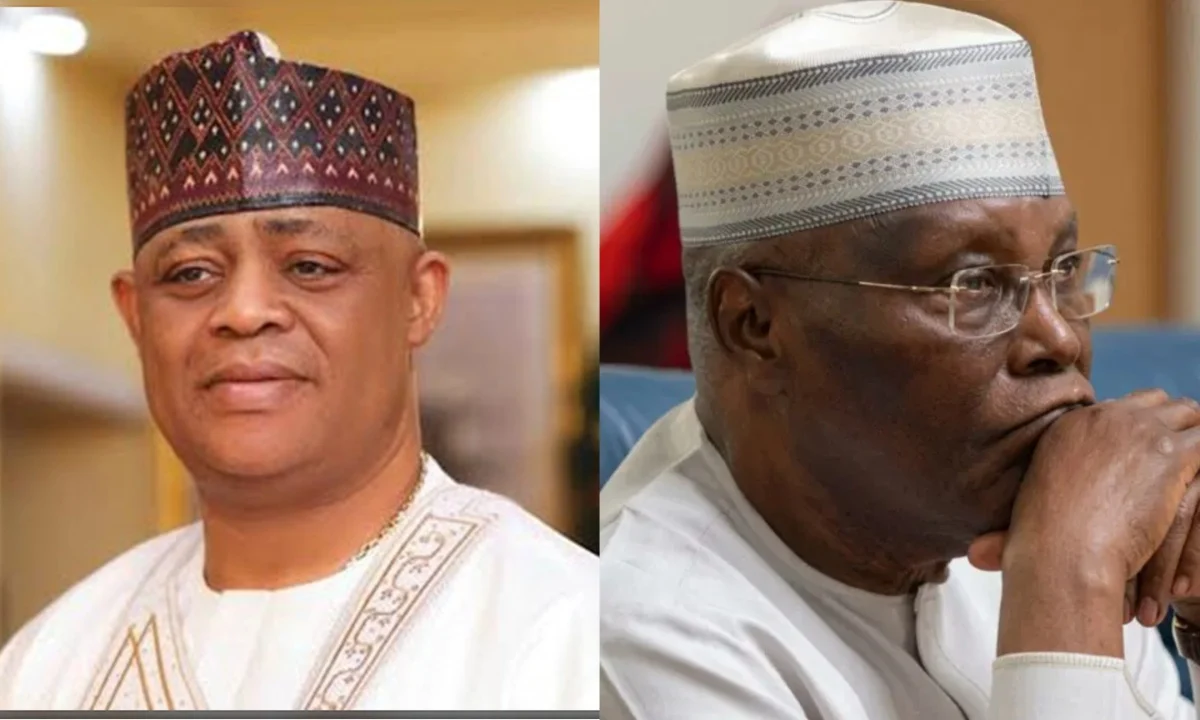
Femi Fani-Kayode, Nigeria’s Ambassador-Designate to South Africa, Lesotho, and Eswatini, has openly criticized former Vice President Atiku Abubakar for consistently referring to President Bola Tinubu simply as “Bola” throughout his October 1 Independence Day broadcast.
Fani-Kayode made the remarks in a post on X while responding to Atiku’s speech, in which the African Democratic Congress (ADC) presidential candidate criticised Tinubu’s administration and repeatedly addressed the President by his first name.
He described Atiku’s address as “calm and well-delivered” but faulted its content and tone, saying it was “intellectually-flawed, highly disrespectful, inherently dishonest and utterly bereft of decency and logic.”
The Former Minister of Aviation said he was particularly displeased that Atiku did not refer to Tinubu as President during the speech.
“Worse still you refused to address @officialABAT as ‘President’ but rather continuously and contemptuously referred to him by his first name ‘Bola’,” he said.
“Surely this level of pettiness is below even you. Yet despite this provocation I will not refer to you as ‘Kachalla’ and accord you the respect that I still think you deserve,” Fani-Kayode added.
The former minister also cited a recent comment by Akin Osuntokun, former Special Adviser on Politics to ex-President Olusegun Obasanjo, who criticised Atiku’s use of Tinubu’s first name.
Quoting Osuntokun, Fani-Kayode said: “Abubakar is entitled to criticise the President, however sharply. What I found objectionable was his repeated decision to call him ‘Bola.’ That was not a more forceful argument; it was a needless display of disrespect.”
“This is not acceptable. It is bad manners and primarily an insult to Nigeria on whose account he occupies that office,” he quoted Osuntokun as saying.
Fani-Kayode also cited Osuntokun’s call for “decorum and decency”, arguing that a former vice president should respect the office of the President even when criticising the occupant.
“Osuntokun is right,” Fani-Kayode said, before launching into a series of criticisms of Atiku’s past political conduct.
He questioned Atiku’s relationship with former President Olusegun Obasanjo, accusing the former vice president of betraying his principal and conspiring with some governors against him.
Fani-Kayode also recalled Atiku’s recent description of former President Goodluck Jonathan as an “inexperienced young man” who “made mistakes”, questioning the former vice president’s assessment of Jonathan’s record in office.
He further criticised Atiku over his reported response to Vice President Kashim Shettima, after Shettima challenged him to account for his tenure in office and his record of empowering Nigerians.
Fani-Kayode also accused Atiku of inconsistency over the 2022 killing of Deborah Samuel in Sokoto, alleging that the former vice president initially condemned the killing before deleting the post.
He said Atiku’s conduct demonstrated what he described as a lack of “respect, decorum and restraint”.
“The truth is that you do not reflect the decency, restraint, patience, humility, good manners, faith in God, loyalty, fortitude, kindness, generosity, charity, compassion, honor, sense of justice and numerous other virtues that are associated with the North but rather it’s antithesis,” Fani-Kayode said.
He also referred to comments attributed to Atiku’s former running mate, Rotimi Amaechi, questioning the former vice president’s political record.
Fani-Kayode concluded by accusing Atiku of prioritising his political ambition and warned that his decision to repeatedly refer to Tinubu as “Bola” could undermine his aspiration to occupy the presidency.
“And because you lack basic respect for the Office of the President and insist on calling him ‘Bola’, you, my dear Waziri, may NEVER attain that height,” he said.
What You Should Know
This political dispute highlights the ongoing tension between prominent Nigerian political figures regarding political etiquette, decorum, and respect for the office of the President. The exchange brings to light discussions on how political leaders address one another in public discourse.
- Positive Impact: Encourages public debate on political decorum, national values, and the importance of respecting institutional offices regardless of political differences.
- Potential Concerns: Deepens polarization among political camps and distracts public discourse from pressing governance and socio-economic issues facing ordinary citizens.