Ahead of the August 15 governorship election in Osun State, the political atmosphere has become increasingly tense, with accusations, counteraccusations, arrests, allegations of intimidation and fears of violence dominating public discourse.
Rather than discussions bothering on what each of the candidates would do in the areas of education, health care, agriculture, youth employment, violence has been the order of the day and the State of the Living Spring is currently in a state of fear and anomie as violence takes the centre stage.
Arrest of political opponents and allegations of police bias, detention of party members, clashes among supporters, and concerns over police neutrality, have dominated discourse.
Although elections in Nigeria have often been characterised by heightened political tension, developments in Osun appear to be sending worrying signals. The state has a long history of fiercely contested elections, and observers fear that unless political actors, security agencies and electoral authorities act responsibly, the state may once again witness avoidable violence.
6 months on, Kaiama abductees still in captivity
N20, N50, N100, nothing to buy
Political analysts argue that while democratic competition naturally produces disagreements, the tone and pattern of events preceding the election suggest that the stakes have risen beyond ordinary political rivalry.
The violent twists
One of the most disturbing features of the current campaign season has been the growing number of allegations relating to politically motivated violence.
Governor Ademola Adeleke, the incumbent governor, has repeatedly accused opposition elements of sponsoring attacks against his supporters. According to him, several members of his political camp have allegedly been killed while dozens have sustained injuries in recent times.
The governor has also alleged that scores of political supporters have been arrested and detained outside Osun State, describing the development as an attempt to weaken his political structure ahead of the election.
On the other hand, security agencies have defended some of their operations, insisting that arrests were based on intelligence and ongoing investigations into electoral offences and criminal activities.
The police have maintained that investigations are being conducted within the law and that no individual is being targeted because of political affiliation.
Nevertheless, the conflicting narratives have deepened public suspicion.
Adding to the anxiety was a recent stakeholders’ meeting organised by the Independent National Electoral Commission (INEC), where political parties were expected to discuss measures for ensuring a peaceful election.
Instead of promoting consensus, the meeting reportedly descended into arguments and accusations.
The African Democratic Congress (ADC) accused members of the All Progressives Congress (APC) and the Accord Party of disrupting proceedings through intimidation and shouting.
According to the ADC, the atmosphere became so hostile that its representatives could not make oral presentations, and instead, submitted their observations in writing.
Whether these allegations are ultimately substantiated or not, they point to an increasingly tense political environment, which is currently the lot of the state.
In June, two deaths were recorded, with one involving an Accord Party supporter who was allegedly shot dead in Esa Oke, and another involving an APC campaigner killed after a truck rammed into a party procession in Ede.
Ajayi Aderogba, popularly known as Rogba, was reportedly shot dead by yet-to-be-identified gunmen.
His killing sparked protest in the community, which falls within Obokun Local Government Area, and immediately triggered accusations between Accord and APC camps.
Residents said Aderogba was killed while preparations were ongoing for a campaign rally in support of Adeleke’s second-term bid.
Also about two weeks ago, two APC members were reportedly killed while several others sustained injuries during a coordinated attack in Osogbo by attackers said to be political thugs.
The party alleged that the thugs behind the fatal attacks were linked to the administration and aides of Governor Adeleke.
There have been several killings and violent attacks in the state ahead of the election, raising fears of electoral violence as the election approaches.
Political parties, governorship candidates, traditional rulers and members of the National Peace Committee during the signing of the Osun State Peace Accord in Osogbo, Osun State on Thursday
Accord Party and presidential endorsement
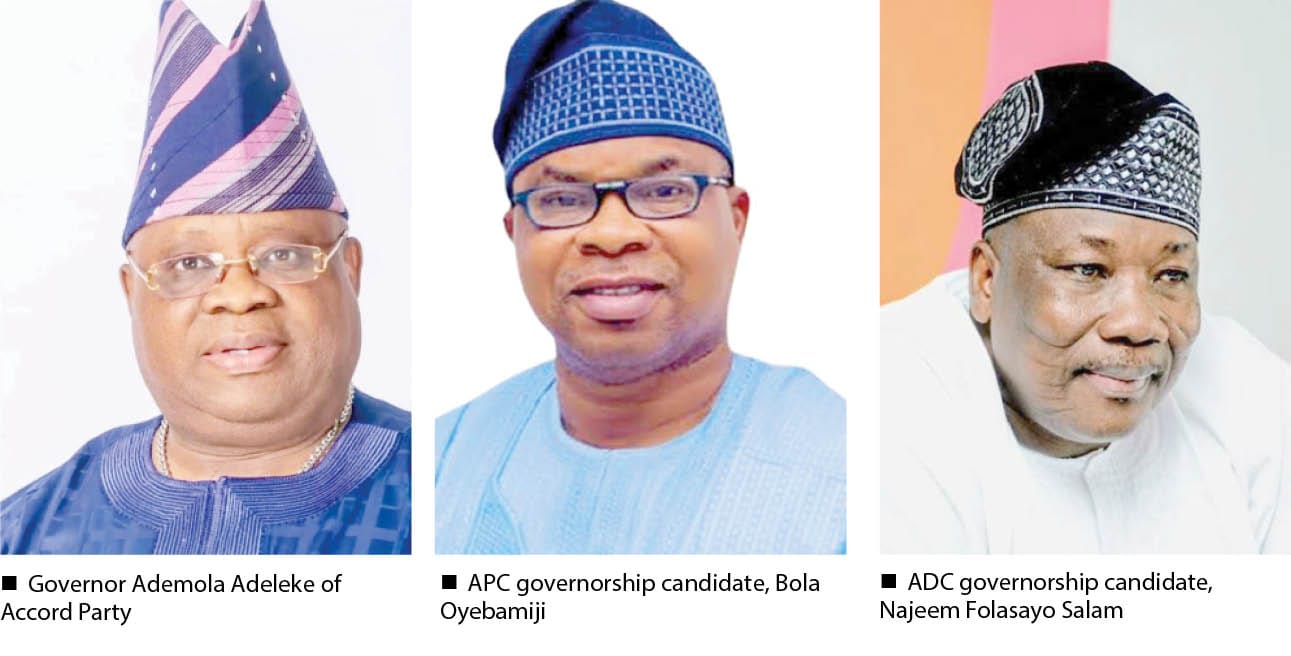
Adeleke, who was elected on the platform of the Peoples Democratic Party (PDP) in 2022, is seeking re-election. However, he is facing one of the stiffest challenges from the opposition APC, whose candidate is Asiwaju Munirudeen Oyebamiji, the immediate past Managing Director of the Nigeria Inland Waterways Authority (NIWA).
One of the controversial developments in the buildup to the election is the endorsement of President Tinubu for a second term by the Accord Party and the governor.
This has fueled speculation that the president might be backing the governor for a second term against the candidate of his party. But recent developments have punctured that speculation. Governor Adeleke has alleged that federal institutions are being deployed against his administration.
He has accused senior federal officials of influencing security operations in Osun, an allegation that has heightened political tension across the state.
While these allegations remain politically contested and have not been established, they have contributed significantly to public debate over the neutrality of federal institutions during elections.
In Nigeria’s federal system, perceptions often matter almost as much as reality.
Whenever a state government accuses federal agencies of partisanship, public confidence in the electoral process can diminish rapidly.
Analysts argue that regardless of which party controls the federal government, security agencies must not only be impartial but also be seen to be impartial.
NURTW connections
Another factor attracting increasing public attention is the alleged involvement of transport unions and motor park interests in the unfolding political contest.
Historically, transport unions have played influential roles in elections across parts of Nigeria.
Their extensive grassroots networks, organisational capacity and ability to mobilise large numbers of people make them attractive allies for political parties.
And ahead of the election, leaderships of the transport unions in the state have been dragged into the fray.
Following the raging tensions and the violence that have trailed the buildup to the election, the governor has ordered the suspension of activities of the National Union of Road Transport Workers (NURTW) in the state.
According to a statement signed by the Commissioner for Information and Public Enlightenment, Kolapo Alimi, the decision followed extensive deliberations on the security situation in the state and the need to restore sanity to motor parks.
Adeleke directed the police and other security agencies to immediately stop all NURTW activities in motor parks across the state, stressing that the order does not include the closure of the parks.
However, the president of the NURTW, Musiliu Akinsanya, popularly known as MC Oluomo, overruled the governor, saying he had no power to dissolve the union.
Weekend Trust learnt that the suspension of the union was as a result of reports that a section of the union, which would be contracted for logistics purpose during the election, might have been compromised. The governor was, however, acting proactively by dissolving the NURTW leadership.
A history that refuses to fade
Osun’s electoral history partly explains why recent developments have generated widespread concern. The state has experienced some of Nigeria’s most fiercely contested governorship elections.
The election that brought in Adeleke in 2022, where the then incumbent, Adegboyega Oyetola, was defeated, was also not devoid of the tensions being witnessed at the moment.
Several elections have ended in prolonged litigation while others have witnessed violent clashes between rival supporters.
While the APC was determined to take a pound of flesh by denying the incumbent the second term bid, just like he did to the incumbent in the last election, the governor has gone for the jugular, making desperate moves to remain in office beyond 2026.
While speaking on Thursday at the peace summit on Osun guber election in Osogbo by the Peace Committee, Adeleke said Osun State was facing “a progression towards genocide,” alleging that his government and Accord Party members had been under “police sanctioned violence and intimidation” for the last three months.
Adeleke said he attended the meeting out of “deep respect” for the peace leaders despite the attacks he blamed on the opposition.
“It is on a sad note that I welcome our peace leaders to Osun State. We are sad because our people, our government and my party men and women have been under siege and attacks for the past three months,” he said.
He told the gathering that in the last three months, eight Accord Party members had been killed and more than 20 others injured in gun attacks, alleging that there has been no single prosecution or active arrest till date.
The governor also claimed that more than 60 Accord Party members were in police detention without being charged to court.
He said the Secretary to the State Government, Teslim Igbalaye, was arrested on trumped-up charges and detained overnight after his house was raided without any court-authorised search warrant.
“More than 60 Accord Party leaders, including a candidate for House of Representatives, Alaba, have been arrested and moved to Abuja and Nasarawa State and remanded in prisons.
“Under which law can a state police commissioner take instructions from Mr Gboyega Oyetola to arrest Accord Party members in Osun State and move them to Abuja and hold them in prisons without any charge?” Adeleke asked.
Security agencies on the spot
Perhaps no institution faces greater scrutiny than the Nigeria Police Force.
Opposition parties and the ruling party have demanded neutrality from officers deployed for election duties.
Political commentators have argued that professionalism will be measured not merely by maintaining order but by ensuring that enforcement actions are transparent, evidence-based and free from political influence.
Recently, the police arrested the Secretary to the State Government, Teslim Igbalaiye and five commissioners, while the governor is crying foul. While the police claimed that those arrested were found with incriminating items like voters’ cards and cash, the state government dismissed the claim.
The command’s public relations officer, Abiodun Ojelabi, in a statement noted that two PVCs, a voter register, Dynabook laptop, one photocopy machine and one printer were recovered from Igbalaiye’s residence.
Others arrested alongside Igbalaiye were Akande Taiwo, 60; Adeyemo Lukman, 45; Olaoye Muftau, 50, and Aderemi Musliu, 40 years.
The police public relations officer said a team acting on the intelligence that some criminal gangs were hibernating at a location in Osogbo carried out a lawful raid and apprehended the suspects.
“During the operation, officers recovered exhibits, comprising a cash sum of N4,810,500, one Dynabook laptop, one photocopy machine, one printer, two permanent voter’s cards and a voter register for wards 1 to 15.
“These exhibits have been secured and are currently in police custody for detailed forensic examination and further investigation,” the police spokesperson stated.
However, the state government and some observers kicked against the police claim. The government accused the police of invading the residence of Igbalaiye without a search warrant.
The Commissioner for Information and Public Enlightenment, Kolapo Alimi alleged that the SSG’s residence was busted by a combined team of police officers led by the Deputy Commissioner for Operations.
He also said that during the incident, members of the Igbalaiye family were arrested and whisked away.
The commissioner said, “The Osun State Government has raised the alarm over systematic invasion, attacks and busting of homes of top Osun State Government officials by the state police command without a proper search warrant, the latest being the invasion of the house of the Secretary to the State Government (SSG).
“The SSG’s residence was busted by a combined team of police officers, led by the Deputy Commissioner for Operations, with family members of the SSG taken to unknown destinations.
“The Gestapo operations on the SSG residence followed a similar raid and arrest at the residences of about six commissioners and other top functionaries of the government.
“This campaign of repression constitutes grave danger to democracy. It is a reprehensible, unprofessional conduct by the police in support of the state All Progressives Congress,” Alimi said.
INEC’s litmus test
Beyond security concerns, the Independent National Electoral Commission (INEC) faces perhaps one of its most delicate assignments in recent years as it must convince voters that every vote will count despite the growing political tension.
The INEC chairman, Prof Joash Ojo Amupitan, reaffirmed the readiness of the commission to conduct a free, fair, credible and peaceful election, assuring stakeholders that all critical preparations have been concluded.
Speaking at the Osun State Governorship Election Stakeholders’ Forum in Osogbo, Amupitan said the commission had completed its logistical, technological and operational arrangements and was fully prepared to deliver an election that would reflect the will of the people.
To encourage greater voter participation, Prof Amupitan announced the extension of the permanent voter card (PVC) collection exercise to Friday, July 31, 2026 after revealing that 322,822 newly registered voters, representing 62 per cent, had collected their PVCs.
He also announced that a mock accreditation exercise would hold on Saturday, August 1 across 12 selected local government areas to test the functionality of the Bimodal Voter Accreditation System (BVAS) before the election day.
Observers said that for INEC, transparency would be its greatest defence, even as the election would serve as the litmus test for the 2027 general election.
How the candidates stand
Although several parties are on the ballot, the contest is expected to revolve around the Accord Party, which is the ruling party; the African Democratic Congress (ADC) and the All Progressives Congress (APC), with each seeking to convince voters that it represents the best option for Osun’s future.
Accord Party: Incumbency under pressure
Governor Adeleke heads into the election with the advantage of incumbency, which remains a major factor in Nigerian political terrain. Since assuming office, his administration has highlighted achievements in road construction, workers’ welfare, education, health care and local government administration.
The governor also enjoys the support of the state’s political machinery, including many elected local government officials and grassroots mobilisers.
His campaign has centred on continuity, arguing that his administration deserves another term to consolidate ongoing projects.
For the Accord Party, the challenge will be converting incumbency into votes, while convincing undecided voters that the current political tension is not a reflection of its leadership.
ADC: Riding on Aregbesola’s influence
The African Democratic Congress enters the race with renewed confidence following the defection of former Governor Rauf Aregbesola, whose political influence remains significant across many parts of Osun.
The party’s candidate, Najeem Salaam, is banking on Aregbesola’s extensive grassroots network built during his eight years as governor, as well as support from politicians who have aligned with the former governor since his fallout with the APC.
Aregbesola has described the ADC as the “main, principal and only political force” in Osun; and has repeatedly expressed confidence that Salaam will emerge victorious.
The ADC has also attempted to portray itself as the platform capable of restoring what it describes as people-oriented governance, while distancing itself from the political conflicts between the ruling party and the APC.
APC: Banking on federal influence
The All Progressives Congress, despite internal realignments over the past few years, remains one of the state’s strongest political organisations.
The party continues to rely on its longstanding structures across the local governments and believes dissatisfaction with the current administration could work in its favour.
Although the APC has rejected allegations of sponsoring violence or influencing security agencies, it has remained a major target of accusations from the ruling Accord Party.
Speaking with Weekend Trust, the executive secretary of Coalition of Democrats for Electoral Reforms, Dr Wunmi Bewaji, said that despite the current tension, the major players remained members of the same family, saying, “As far as the election proper is concerned, I don’t think there is going to be any problem whatsoever.”
He also said that federal might would not play out in Osun, given the affiliation of the governor with the president.
“The ruling party’s candidate has already expressed support for the president’s re-election. That means the usual federal might would play a role in the election. But it is possible for players in Osun who are well affiliated to the federal institutions to utilise them to their benefit,” he said.
News Credit to our media partner DailyTrust Home .