
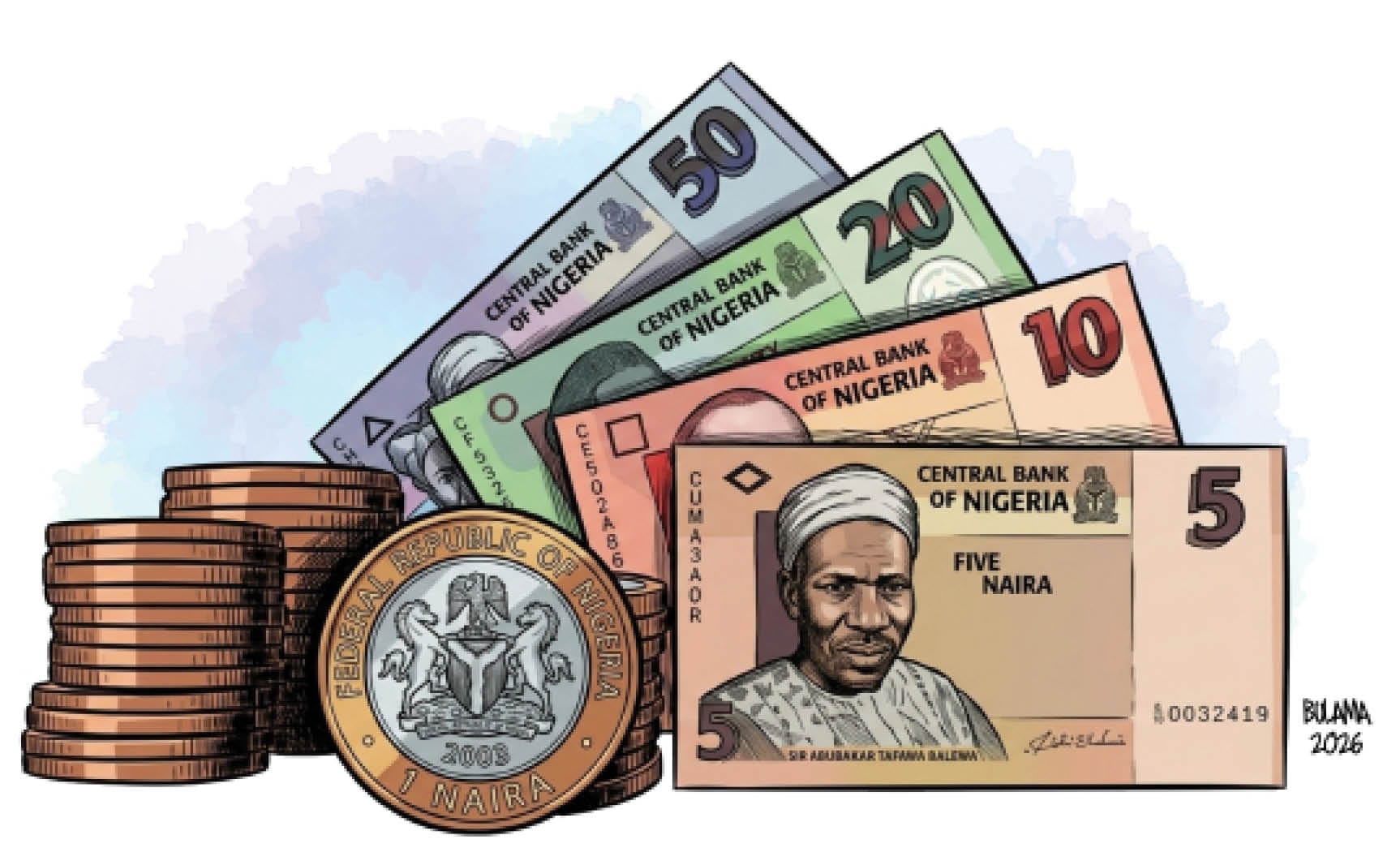
For many Nigerians, N10, N20, N50 and N100 notes were once enough to buy snacks, pay transport fares or purchase everyday household items.
Today, however, those same notes have become symbols of naira’s declining purchasing power as inflation continues to erode their value.
Across markets, roadside kiosks and supermarkets, it is becoming increasingly difficult to find goods that cost N50 or N100. Many traders now regard the notes as inconvenient, while some businesses have stopped stocking products at those price points altogether.
What can these lower denominations buy today?
A visit to several retail outlets shows that N50 now buys very little, as in most urban centres, it may only be enough for a sachet of drinking water, while in some locations, it would only buy one or two sweets or chewing gums, a small nylon bag or other low-value items sold in bulk.
Further checks showed that items that once sold at N50, including biscuits, snacks and several other commodities, have become useless because gone were the days when a N50 note could pay for local transport fares, which have risen several times due to inflation.
In the same vein, the purchasing power of N100 has also shrunk dramatically. Depending on location, N100 may buy only a sachet of water and a few sweets, a single matchbox or small stationery item, or a small quantity of seasoning cubes or pepper in some open markets.
In the same vein, as the prices of goods continue to rise, businesses have been forced to adjust their pricing, leaving just a few products within the N50 or N100 range.
Another challenge is the shortage of lower denomination notes. Many traders complain that they struggle to obtain enough N50 and N100 notes to give customers change, making digital payments or rounding up prices more convenient.
For consumers, especially low-income earners, the disappearance of low-value pricing means spending more on even the smallest purchases. Price rounding has become common, with goods often priced in multiples of N200 or N500 rather than N50 or N100.
Checks by our correspondents across Lagos, Ogun, Oyo, Bayelsa, Kwara, Kano and other parts of the country showed that many traders are not favourably disposed to accepting the notes, which remain legal tender in Nigeria.
Those who spoke with Weekend Trust tagged the notes as “useless” because they hardly find commodities to buy with smaller denominations, including N5, N10 or N20 in the market.
Many traders who spoke to Weekend Trust said the lower denominations were visibly vanishing but they only accept them reluctantly in most cases from stubborn customers who rightly argue that the notes remain legal tender in the country.
Nigerians speak on vanishing notes
An entrepreneur based in Abeokuta, Ogun State, Mrs Abisola Pedro, confirmed to Weekend Trust that many traders now turn away from lesser denominations.
“The smaller notes are no longer in circulation because traders, commercial drivers and some persons no longer collect them. They tag them worthless,” she told our correspondent.
Narrating her experiences, Mrs Pedro said, “I once had an experience with a commuter who rejected 5 pieces of N20 denomination to make up for her transport fare change.
“The woman rejected the money completely from the driver, claiming that it is no longer a medium of exchange. She said, ‘Owo ti won o na mo’ (money that no longer has value). She took her time to look for where to change her own money so she could give the driver, delaying us in the process.
“On another occasion, I had also had cause to give it to a driver as transport fare. Although the man collected it, he wondered where I got it from. He felt insecure with the money that he didn’t add it to all his other money; he put it in a separate place.”
The mother of three admitted: “Honestly, I don’t see what those notes can actually buy. As small as chewing gum is, it is one or two for N50, likewise sachet water.”
She advised the government to phase the notes out of circulation, saying, “If Nigeria’s economy is revived in the near future, the money can still be in use; otherwise it would be good if the government can sweep it off banks.”
But contrary to her views, another resident, Mrs Gbemi Sanni said, “They are not rejecting it; rather, the denominations are going extinct because there is nothing in the market you can buy with it. For example, what do you want to buy with N10 now? Even N20, if you give it to kids now, they are probably going to reject it.”
Taiwo Adedoyin, a resident in Lagos, attributes the reduced circulation of lower denominations to inflation, which has pushed up the prices of goods and services.
She urged the government to address inflation to make smaller denominations relevant again.
“The government should try to lower inflation. Now, the prices of most of the things we buy start from N200.
“If prices of things could be reduced, I feel that lower denomination currencies will become useful and be valuable in the society,” she said.
Christiana Falaranmi shared similar concerns, noting that inflation has made lower denominations almost obsolete in daily transactions.
On the flip side, in Kano, Salisu Gyadi-Gyadi, a petty trader in Tarauni Local Government Area, noted that school pupils usually bought sweets and biscuits from him with lower naira denominations, noting, however, that apart from these, no item is sold less than N50 or N100 in his shop.
The trader said he took whatever amount gathered from the lower currencies to Singer Market, where wholesale dealers would collect them and deposit in banks.
Nura Muhammad, another trader, also said he collected lower naira notes, even mutilated ones and often gave out as change, or he would take them to wholesale dealers at either Sabon Gari Market or Singer Market.
He said that sometimes people who want to give charity (sadaqa) to children usually come to him specifically for lower currencies like N20, N10, which they distribute to children on Fridays or any other day as sadaqa (alms).
Similarly, Hamza Abdullahi, who sells recharge cards, collects lower currencies because the nature of his business requires him to give change to his customers owing to small profit margins.
“If someone wants to buy recharge cards of N1,000 from me, for example, the total amount payable is N960. So, I need the smaller currency to be able to give the person change. I do collect them for this purpose,” he explained.
In Bayelsa, traders explained why they don’t always accept small denominations of naira notes, saying there is hardly anything it could purchase in the market.
Some traders at Swali market in Yenagoa, the state capital, told Weekend Trust that buyers don’t even come with smaller denominations to the market because they seem valueless due to the economic situation in the country.
Madam Lessly Akedei, who deals in foodstuffs, said that even little things like seasoning, pepper, onions and others could not be bought again with smaller denominations, thereby making it difficult for them to accept it.
“If it is brought as change, like N20 into five places, making it N100, I can collect. But I can assure you that if you move around this market, you won’t see anything being sold for N20; even children’s sweets.
“The government and Central Bank of Nigeria should reconsider the denominations and see if they are still meaningful to the economy,” she proposed.
A fuel attendant at a filling station in the Amarata axis of Yenagoa told Weekend Trust that customers hardly come with such denominations because the price of petrol is high.
In Ilorin, Kwara State, traders across major markets and shops expressed concern over the gradual disappearance of lower naira denominations. They lamented that the scarcity of N20, N50 and N100 from circulation affects their daily transactions and customer relations.
Many of them noted that the smaller notes had become so scarce that even basic items that were cheap now sell at a higher price, forcing customers to buy more than they need, or abandon their intended purchases.
A trader, Mrs Fatimah Abdulsalam, said the lower denominations were now rarely seen, making business transactions difficult.
“We don’t usually see these lower denominations anymore because of their scarcity,” she said.
Another trader, Mrs Omowumi, who sells household items in the Murtala area of Ilorin, described her daily experience as frustrating. “We hardly receive or use these currencies now because we don’t have them. At times, customers who have N20 as balance are told to pick an item worth that amount. Sometimes, they even pay more than they should because we don’t have smaller notes to give as change.
“When I am going to the market to restock, I don’t even bother taking those denominations along because they are not available,” she said, adding that the scarcity has changed her buying habit.
The Central Bank of Nigeria (CBN) has acknowledged that lower denominations remain legal tender, but says their scarcity is largely driven by declining demand as electronic payments become more common.
Meanwhile, economists say this reflects not only inflation but also the weakening purchasing power of the naira over time. Lower denominations that once played a significant role in daily transactions are increasingly becoming symbolic rather than practical.
Five years ago (2021), N20 could buy a single sachet of pure water or a small sweet. N50 could buy a single fresh egg, one medium-sized loaf of bread (known as Agege bread in some areas, or two single candies like Tom Tom.
N100 secured a standard loaf of sliced bread or a small pack of noodles.
Also N50 could buy cornmeal, now N100 per wrap.
Also, a sachet of tea or coffee beverages used to be N100 five years ago but now N300 esch and the new three-in-one sachet costs almost N400 now.
100 could buy you two super packs of indomie or 3 packs of small sized indomie but a small sized-pack of Indomie now costs N300 to N400.
N100 can buy 60 leaves of exercise book and N10 will get a pencil or cleaner.
Five years ago, N100 could get a leather of moi moi and agidi.
Five years ago, bike men and taxi drivers collected N50, N100 from passengers the shortest distance especially in Abeokuta, Ogun State, but now it’s N200 upward.
‘Inflationary trend weakening naira’
Reacting to the development, Dr Abdulrauf Babalola of the Department of Economics, Al-Hikmah University, Ilorin, said the situation is a reflection of the country’s inflationary trend and the weakening value of the naira.
He described the fading out of lower denominations as an economic concern that goes beyond scarcity of printing, saying it shows that the economy is outgrowing the smaller notes due to continuous inflation.
“It is not a good development because these denominations form part of our legal tender. But today, you can hardly find N10 or N20, not to mention coins. The reality is that our economy has outgrown them, and that shows the level of inflation in the country,” he said.
Babalola explained that while government data sometimes show a decline in inflation, the figures are mostly influenced by temporary drops in food prices, whereas other critical sectors like building, manufacturing and transport remain high.
“In reality, prices of building materials, rent and manufactured goods have not gone down. What is happening is that food inflation may drop because of seasonal factors, but it doesn’t mean that the overall inflation rate is truly reducing,” he noted.
The economist said the vanishing of small notes had a ripple effect on the economy, especially on micro and small-scale businesses that depend on minor transactions.
“When these lower denominations vanish, it reduces small-scale trading, which directly affects small and medium enterprises. You can’t buy bread at N200 and tea N100 anymore. Everything starts from N500 and above, and that shrinks the market for petty traders,” he explained.
He added that the disappearance of the notes reduces consumer purchasing power, discourages savings and limits the flow of cash in rural and informal markets.
“The monetary authorities need to look into this situation seriously. In the past, N50 could buy gari, kulikuli and sugar, but today, N50 can hardly buy anything meaningful. That shows how much the naira has lost value,” he added.
A legal practitioner, Osho Adeniyi said that all denominations of the naira remain legal tender under the Nigerian law despite their declining use in daily transactions.
“As far as the Nigerian law is concerned, they are all still legal tender irrespective of how the citizens may view it. Comparing it with the market value, they are still legal tender acceptable for transactions in Nigeria; the value attached to it is where the problem lies.”
It’s a matter of demand and supply – Cardoso
Meanwhile, the Central Bank of Nigeria (CBN) says lower denominations of the naira are currently scarce due to growing adoption of digital payments and changing currency demands.
Olayemi Cardoso, the governor of the apex bank spoke on Tuesday after the Monetary Policy Committee (MPC) meeting in Abuja. He said Nigerians should continue to accept the smaller denominations, noting that the CBN has not withdrawn any denomination from circulation.
“They remain legal tender unless the central bank states otherwise, Nigerians should assume that all existing denominations remain legal tender.
“As to why there appears to be fewer of these notes in circulation, it is largely a matter of demand and supply. The financial ecosystem is evolving in the direction we want it to, with greater financial inclusion and increased digitisation.
“As more people adopt digital payment channels, the demand for coins and lower-denomination notes naturally declines. If there is less demand for them, there is less need to print and circulate them in large quantities,” Cardoso said.
He also said the declining purchasing power of lower-value notes contributed to their reduced use.
“Of course, we must also acknowledge that currency devaluation has affected the purchasing power of lower-value notes. That is a reality. More importantly, however, as financial inclusion expands and digital payments become part of everyday life, fewer people will rely on these denominations,” he said.
Contributions from Philip Shimnom Clement (Abuja), Peter Moses, Dotun Omisakin (Lagos), Mumini Abdulkareem (Ilorin), Ahmad Datti (Kano) & Bassey Willie (Yenagoa)
News Credit to our media partner DailyTrust Home .


