
A fresh series of security alerts has targeted at least 21 planes and multiple airports throughout Europe, causing flight disruptions across eight nations in what marks the second wave of such security incidents this week.
The BBC reported that flights to Austria, Belgium, Bulgaria, the Czech Republic, France, Italy, Poland and Romania were affected on Thursday, with the UK describing the threats as a “malicious hoax”. No explosives have been found following security searches, while authorities are yet to establish whether the incidents, some claimed by a little-known group, are connected.
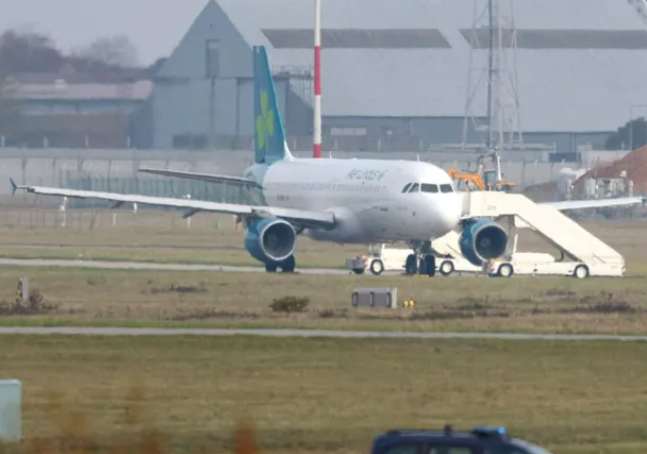
An Aer Lingus flight from Dublin to Rome was diverted to a military air base in Normandy, France, while Italian fighter jets escorted a Finnair aircraft travelling from Helsinki to Rome.
EasyJet also confirmed that its flights from Newcastle and Glasgow were met by police in Prague as a precaution. Meanwhile, London Heathrow and Birmingham airports received threats which were assessed as not credible.
Airport authorities in Rome said the threats against two inbound flights on Thursday were received by email. The messages were reportedly signed by a group or individual identifying themselves as “Fighters of the Male State”.
The sender claimed to be targeting a “feminist regime” and expressed a desire to “make our mark on history”, while threatening to “turn the skies red” with explosions.
The details, first reported by Italian media, were confirmed to the BBC by Aeroporti di Roma, which manages the two airports in the Italian capital.
“Fighters of the Male State” is believed to refer to the Russian group “Muzhskoi Legion”, or “Male Legion”, an ultra-right organisation banned by a Moscow court in 2021 because of its extremist views. The group reportedly retained tens of thousands of online followers and supported Russia’s full-scale invasion of Ukraine in 2022.
However, the email may not provide sufficient information for investigators to identify those behind the threats or establish their motives.
UK Transport Secretary Heidi Alexander described Thursday’s incidents as “malicious hoax threats”, saying the government was taking “these threats seriously”.
She added that there were “established processes for dealing with hoax and malicious threats”.
A UK government spokesperson later said the threats reported “in the early hours” had been “resolved”, without providing further details.
Heathrow Airport said in a statement that a threat received earlier in the day was “deemed not credible”, adding that there was “no risk to passengers, colleagues or the aircraft”.
“There are robust UK aviation security standards in place to assess and safely manage these types of situations,” the statement said.
Birmingham Airport also confirmed receiving a threat, saying “processes were immediately initiated in conjunction with emergency services and partners”.
Among the flights affected, Aer Lingus said its Dublin-Rome service diverted to Normandy and landed safely. The airline said it was working to “re-accommodate customers to their final destination as soon as possible”.
Finnair confirmed that two flights from Helsinki landed safely at their destinations. One was escorted into Rome’s Fiumicino Airport by Italian Air Force fighter jets, according to Aeroporti di Roma, while the other landed in Vienna.
Wizz Air said two flights departing from Milan were affected. One, travelling to Warsaw, was diverted to Vienna, while the other landed safely in Bucharest, where teams inspected the aircraft.
Polish airline LOT said its Warsaw-Brussels flight landed as scheduled and that “no suspicious items were found”. Another service from Warsaw to Paris was stopped before take-off, with the aircraft and baggage subjected to security screening. No hazardous items were discovered.
Three Ryanair flights landed in Bulgaria, according to local media. Two services from Copenhagen and Madrid arrived in Sofia, while another flight from London, originally bound for the Bulgarian capital, landed in Plovdiv. The aircraft were escorted by Bulgarian Air Force fighter jets.
Czech police said searches of four flights that landed in Prague found no explosives. EasyJet subsequently confirmed that its services from Newcastle and Glasgow were among those affected, adding that “Passengers on both flights disembarked normally”.
Aegean Airlines said it “was informed of a bomb threat” involving two of its flights travelling from Thessaloniki to Milan and Athens to Vienna. The airline described the threat as “unfounded”, confirming that both flights departed from their respective airports.
A Ryanair flight from Porto, Portugal, also landed safely in Milan as scheduled, with bomb disposal experts inspecting the aircraft on arrival, Italy’s Ansa news agency reported.
Spain’s airport authority confirmed receiving threats involving three flights at Madrid Airport, but said inspections ruled out any danger. Iberia later said two of its services, from Milan and Rome to Madrid, were affected.
Air Serbia also confirmed that its Belgrade-Bucharest flight “landed safely at its destination airport”. Following security checks, the reported bomb threat was “assessed as unfounded”.
Passengers aboard the diverted Aer Lingus flight described the uncertainty during the incident. Emily Noble, a 26-year-old from Dublin travelling to Rome for a friend’s wedding, told BBC Verify that she was about an hour into the journey when passengers were initially informed of a “technical” problem.
As the aircraft began circling before its unexpected landing in France, the pilot announced a “security” issue.
Noble described the experience as “an odd experience”, adding: “It was worrying because we didn’t know what was going on, but we were all trying to be as calm as we could.”
She said she heard fighter jets during the landing and saw one touch down behind the aircraft.
After landing at Évreux-Fauville air base in Normandy, passengers were informed that the flight had been targeted by a bomb threat. They remained on board for about two-and-a-half hours while police and military personnel conducted checks, including searches with sniffer dogs.
Passengers were later informed that they would be transported to an airport in Paris, where another aircraft would take them to Rome.
Philip Baum, a professor of aviation security at the University of Coventry, said the industry “faces multiple bomb threats every single day”, but admitted he had been “surprised” by the incidents recorded this week.
He explained that a flight is diverted “only when the threat is credible and the authorities believe there is a potential of explosive device on board”.
Baum warned that repeated false alarms could create a dangerous situation, saying “if you issue enough hoax threats, then complacency could set in and a real threat could be ignored – or they could be a diversion”.
Marco Chan, an aviation expert at Kingston University, told the BBC that the latest threats were “most likely a hoax, but the system is right to treat it as real”.
He said some experts viewed the incidents as “possibly part of a pattern of cheap, deniable disruption” to air travel.
Chan added that although copycat incidents were possible, “three days of incidents is too small a sample to separate coordination from contagion”.
The latest threats come two days after seven European flights, including two from the UK, were searched following similar warnings. No explosives were discovered on any of the aircraft.
On Monday, a Wizz Air flight travelling from London Luton Airport to Sofia was escorted by a Hungarian fighter jet to Budapest after a bomb threat was reported mid-flight.
What You Should Know
A fresh wave of coordinated bomb threats targeted multiple airports and aircraft across eight European countries, forcing emergency diversions, fighter jet escorts, and thorough security checks. Although authorities and transport officials have labeled the alerts as malicious hoaxes with no explosives actually found, the incidents have triggered heightened security protocols across international aviation networks.
- Positive Impact: Robust aviation safety standards and swift emergency response protocols ensured that all affected aircraft landed safely without any injuries or loss of life reported.
- Potential Concerns: These recurring malicious hoaxes cause significant travel delays, passenger anxiety, operational disruptions for airlines, and increased security costs for international airports.