T he publication of President Bola Ahmed Tinubu’s nomination documents for the 2027 presidential election by the Independent National Electoral Commission (INEC) has rekindled public interest in the controversy surrounding his educational credentials, which featured in the 2023 election litigation, Daily Trust reports.
This is just as the INEC has clarified that it does not verify authenticity of academic certificates and other credentials submitted by candidates before publishing them for public scrutiny.
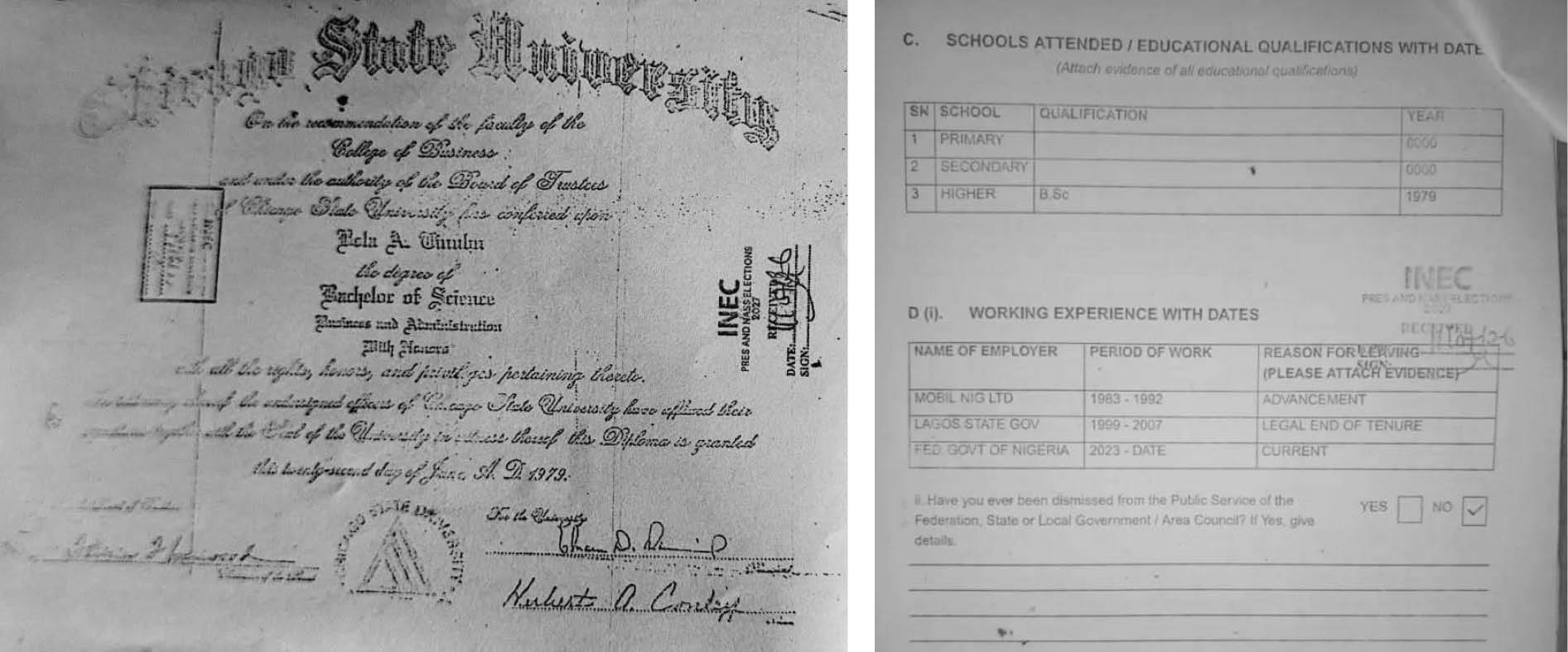
In the credentials of presidential candidates it released on Saturday, the INEC had listed only Tinubu’s Bachelor of Science in Business Administration from Chicago State University (CSU) in 1979, with no primary or secondary school qualifications among the documents made public.
The spaces provided for primary and secondary school qualifications on the summary page of the form were left blank. The president attached copies of his BSc certificate and the National Youth Service Corps (NYSC) certificate as supporting documents.
| Daily Trust’s economists to FG: Convert gains to structural transformation
Abuja infrastructure boom pushes up rent
The presidential candidate of the African Democratic Congress (ADC), Atiku Abubakar, listed his own qualifications as First School Leaving Certificate (FSLC) obtained in 1954 and West Africa School Certificate (WASC) obtained in 1961 without naming the schools. He also indicated that he obtained Masters of Arts in International Relations in 2020 from Anglia Ruskin University.
The presidential candidate of the Nigeria Democratic Congress (NDC), Peter Obi, indicated that he attended St. Augustine’s Primary School, Anambra (1973), Christ the King College (WASC, 1978) and the University of Nigeria, Nsuka, for his BA in Philosophy in 1984.
The omission of Tinubu’s primary and secondary school qualifications has revived memories of the legal battle that followed the 2023 presidential election, when Atiku, who was the then presidential candidate of the Peoples Democratic Party (PDP), alleged that he submitted a forged diploma from CSU to the INEC.
At that time, although CSU confirmed that Tinubu graduated from the institution in 1979, disputes over the diploma allegedly submitted to the INEC became one of the central issues in the post-election litigation. Both the Presidential Election Petition Court and the Supreme Court dismissed the challenges and upheld Tinubu’s election.
In separate interviews with Daily Trust yesterday, lawyers and opposition parties questioned the omission of the president’s primary and secondary school qualifications from the documents released by the electoral body.
They said the omission had reopened unresolved public concerns over Tinubu’s educational qualifications, calling for greater transparency in the disclosure of candidates’ documents.
You can’t be president without secondary school certificate – SANs
A Senior Advocate of Nigeria, Mumini Jimoh, said education up to the secondary school level is one of the basic qualifications prescribed for presidential candidates, making it practically impossible for anyone who does not possess the requisite qualification to validly contest the election.
“Before we say whether it has any significance or not, we have to look at the requirements of presidential candidates under the law. From what I know, the president must have a secondary school certificate. If that requirement is missing, then there is a fundamental error which is going to be a problem in the future,” he said.
Jimoh, however, expressed confidence that the omission was most likely an administrative or uploading error rather than a failure by the president to meet the constitutional requirement.
“I’m sure the president is smarter and would not have done that. I want to believe it must have been an error. Basically, you must have that as a prerequisite; otherwise you cannot contest,” Jimoh said.
Another SAN, Mohammed Abeni, said the omission of a secondary school qualification from the uploaded documents creates an obvious gap that naturally raises questions and fuels suspicion, particularly against the backdrop of the controversies that have trailed the president’s educational records.
“If you want to upload somebody’s qualifications, you start from primary school, then secondary school and then university. You don’t jump from primary school to university. That gives room for suspicion, especially for a president that has been dogged by academic controversies.
“Where is his secondary school education? Which secondary school did he attend? What qualification did he obtain there that qualified him to go to the university? Those are the issues people will naturally raise,” he said.
He argued that the omission has legal implications because the constitutional requirement relates to education up to the secondary school level rather than university education.
“The requirement is secondary school level, not university. If the law says secondary school level and that is what is not there, then it has legal implications. You cannot jump from primary school to university,” he added.
A constitutional lawyer, Danjuma John, said to be legally eligible for a presidential election in Nigeria under the current constitutional provisions, a candidate must, among other fundamental criteria, must have at least school certificate or its equivalent.
According to him, under Section 318(1) of the Constitution, “School Certificate or its equivalent” includes an SSCE/WAEC certificate, Grade II Teacher’s Certificate, Primary Six Certificate combined with relevant public/private service experience, or other credentials approved by the Independent National Electoral Commission (INEC).”
However, Taiye Oniyide (SAN) disagreed, insisting that the omission carries no adverse legal consequence and should not be confused with constitutional qualification.
“As far as the law is concerned, there is no negative implication. The law does not say that if there is no secondary school certificate, you cannot be president. There is a university qualification, which is even higher than secondary school,” he said.
Oniyide maintained that while the omission may generate public debate and moral questions, it does not amount to constitutional disqualification.
“People may ask why there is a university qualification without a secondary school certificate. Those are moral issues. But as far as legal implications are concerned, there are none. He is qualified based on the documents uploaded,” he said.”
We published candidates’ credentials for public scrutiny – INEC
The INEC explained that under the Electoral Act 2026, its responsibility is to publish candidates’ personal particulars and supporting documents for public scrutiny, while any challenge to the authenticity or adequacy of those documents is a matter for the courts.
Its Deputy Director of Voter Education and Publicity, Wilfred Osilama Ifogah, stated this yesterday while responding to inquiries from Daily Trust on the publication of candidates’ credentials for the 2027 general elections.
“It’s not the responsibility of the commission to verify the authenticity of credentials of candidates,” Ifogah said.
Asked whether the INEC authenticates certificates before making them public in view of past controversies over candidates’ qualifications, the spokesman referred to the provisions of the Electoral Act 2026.
“The publication is done so that the public can scrutinise it,” Ifogah emphasised.
President hiding something – ADC, NDC
The African Democratic Congress (ADC) alleged that Tinubu was trying to “hide something” by refusing to list his primary and secondary school qualifications in the INEC form.
Its National Publicity Secretary, Mallam Bolaji Abdullahi, told Daily Trust that “By omitting these levels of education, he (Tinubu) seems to be giving credence to the rumour that he has something to hide in relation to his claims. For us as a party, the president of Nigeria should not have that kind of secrecy around him.
“ADC is worried as to why is the president refusing to list his primary and secondary school certificates, because by doing that, he appears to be giving credence to the speculations that he did not really attend those schools that he claimed to have attended in the past.
“There have been widespread suspicion that the president claimed to have attended some schools in the past.”
Also reacting, the National Publicity Secretary of the Nigeria Democratic Congress (NDC), Osa Director, who spoke to Daily Trust, described the non-inclusion of primary and secondary school qualifications of Tinubu in the INEC form as strange and surprising.
He stated: “It is surprising because we all know that you cannot get a university certificate without primary and secondary school certificates, which are prerequisites.”
He said added that it is time for the president’s media aides to clarify the whereabouts of their principals’ credentials.
Labour Party dismisses concerns
Meanwhile, the Labour Party (LP) yesterday dismissed concerns over the omission of Tinubu’s primary and secondary school qualifications from the INEC form.
The party’s National Publicity Secretary, Ken Asogwa, told one of our correspondents that “So long as the Electoral Act does not make the submission of the primary and secondary school certificates mandatory, I do not see any legal infraction.”
“It is also worth recalling that the president’s qualification to contest the last presidential election was extensively litigated before the Presidential Election Petition Tribunal and, ultimately, before the Supreme Court, which affirmed his eligibility to stand for the election,” Asogwa said.
He questioned the renewed attention being given to the issue, saying Nigerians were more interested in credible alternatives and policy options ahead of the next general election.
Tinubu carrying burden of diminished moral legitimacy – Atiku
The ADC’s presidential candidate, Atiku Abubakar, has said if the reports are accurate that the particulars published by the INEC did not include Tinubu’s primary and secondary school qualifications, it is not a routine administrative omission.
The former vice president, in a statement made available to Daily Trust yesterday by his Senior Special Assistant on Public Communication, Phrank Shaibu, said: “It goes to the very heart of transparency, credibility and the legitimacy of public office.”
According to him, Nigerians deserve a president whose public records can withstand the highest level of scrutiny without contradiction, confusion or controversy.
He asked the Presidency to stop dismissing legitimate questions as political attacks and provide clear and verifiable answers, stressing that “transparency is not a favour to Nigerians; it is a constitutional obligation.”
He stated: “There is a reason our constitution and electoral laws require aspirants seeking elective office to disclose their educational qualifications. The objective is not to satisfy mere bureaucratic formalities. It is to ensure that those who seek the people’s mandate come before the electorate with public records that are open, verifiable and beyond reproach. Legitimacy is strengthened when transparency is unquestionable.
“For years, Nigerians have been told to move on whenever legitimate questions were raised about President Tinubu’s academic records. Yet, instead of laying every doubt permanently to rest, fresh controversies continue to emerge. Rather than close the chapter, each new development appears to reopen it. Instead of certainty, Nigerians are offered ambiguity. Instead of transparency, they are confronted with opacity.
“A president whose public records remain persistently shrouded in controversy carries the burden of diminished moral legitimacy. That burden does not rest on the president alone; it is unfairly transferred to every Nigerian, who must defend the reputation of a country whose highest office should be beyond avoidable controversy. It is a needless source of national embarrassment.
“The Presidency cannot demand that Nigerians ignore what is plainly before them. Public office, especially the Presidency, is founded on accountability—not secrecy. “The burden rests squarely on President Tinubu and the APC to explain why credentials that should ordinarily be straightforward continue to generate public controversy years after assuming office.
“The world expects the highest standards of integrity from the leader of the world’s largest black nation. Nigeria’s president should inspire confidence through openness, not invite endless questions through opacity. Unfortunately, the veil of secrecy that has come to define President Tinubu’s public records and the culture of opacity surrounding his administration does little to uphold the dignity of Nigeria or the pride of black people across the world.”
President must explain missing credentials in INEC form – Ex-minister
Former Sports Minister Solomon Dalung, on his X account on Saturday, challenged Tinubu to explain why the sections for his primary and secondary school qualifications were left blank in the credentials he submitted to the INEC for the 2027 presidential election.
He said, “If there is a perfectly reasonable explanation, Nigerians deserve to hear it. Public office, especially the presidency, is built on public trust. Trust flourishes where there is openness, not ambiguity,” he stated.
Presidency, APC mum
As of the time of filing this report, text and WhatsApp messages sent to the two presidential aides were also not replied to.
Similarly, Felix Morka, the National Publicity Secretary of the All Progressives Congress (APC), neither answer calls placed to his telephone line nor responded to a WhatsApp message sent to him.
Tinubu’s previous certificate controversy
In 2023, former Vice President Atiku Abubakar alleged that Tinubu submitted a forged diploma from Chicago State University (CSU) to the INEC as part of the documents for his nomination for the February 2023 presidential election.
Atiku, who challenged Tinubu’s qualification before the Presidential Election Petition Court, tendered copies of Tinubu’s academic records and other documents, alleging that they contained inconsistencies, including different names and other discrepancies.
On 6 September 2023, the Presidential Election Petition Court dismissed Atiku’s petition, holding that he had not proved the allegation of forgery.
Atiku then approached a U.S. federal court seeking access to Tinubu’s academic records from Chicago State University for use in his appeal before Nigeria’s Supreme Court. The U.S. court granted the request, and the CSU released academic records and allowed its registrar to give sworn testimony.
The CSU confirmed that Tinubu attended the university and graduated in 1979 with a Bachelor of Science in Business Administration. However, during testimony, university officials said they could not authenticate the specific diploma Tinubu submitted to the INEC because they did not know how it had been produced. This fuelled arguments from Atiku’s legal team that the certificate was questionable.
Tinubu’s lawyers argued that any differences resulted from replacement diplomas issued years after graduation and maintained there was no forgery.
In October 2023, the BBC’s Global Disinformation Team concluded that there was no evidence Tinubu forged his Chicago State University diploma, while noting that replacement diplomas can differ from originals. Some Nigerian media and analysts disagreed with aspects of the BBC’s interpretation, arguing that CSU’s testimony left unresolved questions about the specific diploma submitted to INEC.
On October 26, 2023, the Supreme Court of Nigeria unanimously dismissed Atiku’s appeal and upheld Tinubu’s election, holding that the fresh evidence from the United States did not establish that Tinubu submitted a forged certificate or justify overturning the election.
News Credit to our media partner DailyTrust Home .