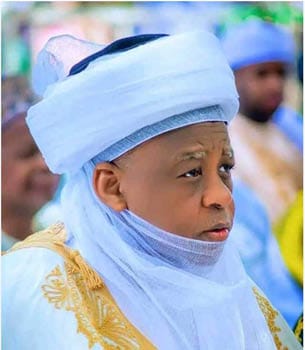
On November 2, 2006, Your Eminence, Alhaji Muhammadu Sa’ad Abubakar III, formally took his place on the revered throne of the Sokoto Sultanate, marking two decades since becoming the 20th Sultan and the spiritual leader of Muslims across Nigeria. This ascension was not merely a matter of chance, as you stem from a distinguished royal and religious lineage tracing directly back to the renowned 19th-century jihadist and reformer, Shaykh Uthman bn Fodio.
But to be born of the best and of the great is not to become great. To inherit wealth and riches does not mean that plenitude would be the heir’s permanent companion. Though you were born of royalty over seventy years ago, you learned very early in life that you must learn how to be royal. Though he is an heir to greatness, the Sultan knew that he needed to acquire the qualities of great men and women. This demanded, among others, that he led ordinary life in order for him to become extraordinary.
In other words, in order for him to fulfill his destiny, the prince in the Sultan realised that he must forge a bond with the talakawas; the Sultan-in-waiting must temporarily shed the toga of royalty in order to merit being vested with the munificence and authority of royalty in future.
Thus it became history – your sojourn at the Barewa College, Zaria. It became history- your layover at the then Nigerian Defence Academy in 1975 (18th Regular Course); it became history- your years of service as a military officer at Nnewi, Nsukka, Saki, Ilorin, Bauchi, Baga – and in Chad and Sierra Leone. In order to be served, you displayed exemplary service as the head of the Presidential Security Unit for General Ibrahim Babangida in the late 1980s. In order to be served, you displayed exemplary service as the Nigerian Defence Attaché to Pakistan, Iraq, Saudi Arabia, and Afghanistan. By the time you retired from the Nigerian Army as Brigadier General, you had put in decades of unblemished, meritorious service to the nation.
Thus, when destiny beckoned to you to become the President-General of the Nigerian Supreme Council for Islamic Affairs (NSCIA) and Jama’atu Nasril Islam (JNI) twenty years ago, after the death of your elder brother, Sultan Muhammadu Maccido, your eminence, Alhaj Muhammad Saad Abubakar III, had already become the primus inter pares in the Sultanate royal lineage. You had already acquired the experience that would be necessary for you to lead an extremely challenging Ummah like ours in Nigeria. You had acquired the necessary experience in patience, tolerance and peace-building. Nigeria already had a Sultan imbued with humility, courage, and a profound sense of duty.
For two decades, you have shown, demonstrated and displayed the ‘tradition’ in traditional qua Sultanate authority – the tradition of Islam: the tradition of peace and justice, of brotherhood and uncommon leadership. Here we have a Sultan who knows what the Sultanate feels; there you have a Sultan who feels the pain of the masses; there you have a Sultan who connects seamlessly with the high and the low; here we have a Sultan whom the people are proud to revere, a Sultan in and from whose persona and personality the Muslims are proud to define his identity.
Sir, the twenty years that you have spent at the head of the Sultanate feel like ten days. Twenty years feels like ten days simply because you have added value to the Islamic commonwealth in Nigeria. Shall we then ponder how your fortieth year on the throne shall be? Together we shall all be there to give glory to the Almighty, Aamin.
What You Should Know
This article celebrates the 20th anniversary of Alhaji Muhammadu Sa’ad Abubakar III as the Sultan of Sokoto and the President-General of the Nigerian Supreme Council for Islamic Affairs. It highlights his journey from a dedicated military career to a unifying spiritual leader who champions peace, tolerance, and community development across Nigeria.
- Positive Impact: His steady leadership has fostered interfaith harmony, peace-building, and a strong sense of brotherhood among diverse communities in Nigeria over the past two decades.
- Potential Concerns: Navigating the complex socio-religious challenges of the Nigerian Ummah requires immense resilience, patience, and continued commitment from traditional and religious institutions.