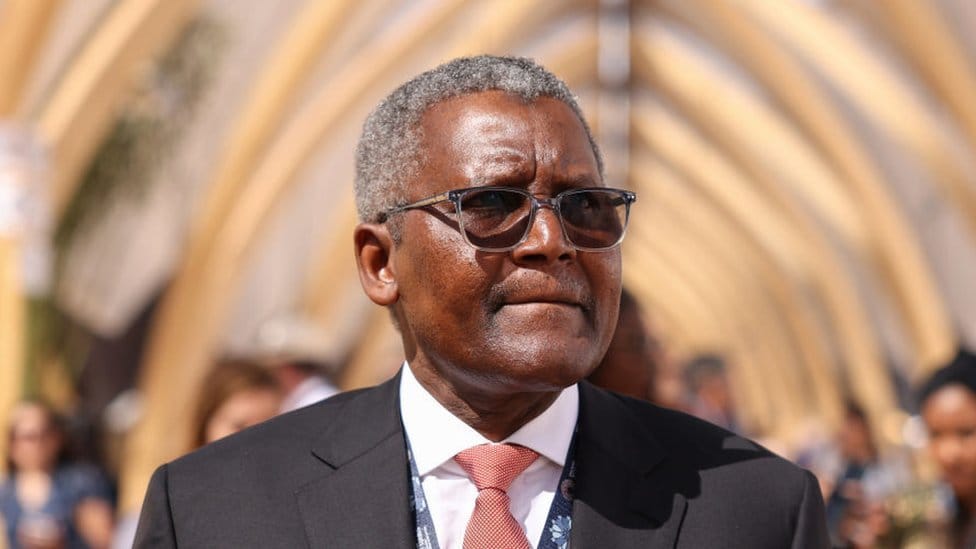
Aliko Dangote, the Chairman of Dangote Industries Limited, has revealed that the initial public offering for the Dangote Petroleum Refinery fell short of its goal to draw in 10 million investors.
Speaking in Lagos at the 25th annual conference of the Women in Management, Business and Public Service (WIMBIZ) in Lagos, Dangote, however, said the public offer recorded significant participation, attracting millions of investors despite not reaching the projected figure.
According to him, the company is yet to establish the official number of investors who participated in the offer, as the necessary reports are still being compiled.
“We cannot tell the figure right away because we have not reported to this, but we’ve gotten an amazing demand from various people,” Dangote said.
He compared the level of participation in the refinery’s IPO with previous major public offers, including those of Nigerian and international companies, arguing that the number of subscribers was substantial.
“If you look at it, the largest participating shareholders, like here now, was I think GTBank. When they did their own, it was 200,000. Okay, we are talking about millions of people that participated,” he said.
Dangote also referenced Safaricom’s public offering in Kenya and the Saudi Aramco IPO, noting that both attracted fewer investors than the refinery’s anticipated participation.
“Even in Kenya, Safaricom was the largest, less than 900,000. Saudi Aramco worldwide was about five million. So, and I’m sure we are not that far away,” he said.
Explaining why the refinery did not achieve its 10 million-investor ambition, the industrialist identified the limited duration of the offer and inadequate awareness of the subscription process among potential investors as major factors.
“We didn’t hit the 10 million because of time constraint, and a lot of people, they didn’t know how to access,” Dangote said.
Despite the shortfall, he described the response as evidence of growing public confidence in investment opportunities offered by African businesses, saying more people were becoming willing to commit their savings to formal investments.
“But it’s the shared trust of public enterprise that we have today in Africa, and that’s why people are now beginning to remove that money under their mattresses to go and invest,” he added.
The Dangote refinery public offer, branded The People’s IPO, was designed to widen public participation in the ownership of the country’s largest refinery by providing retail investors with an opportunity to acquire shares in the business.
The offer comprised 4.1 billion shares priced at N525 each, with a minimum subscription of 10 shares, amounting to N5,250.
It opened on September 14 and was initially scheduled to close earlier but was subsequently extended until October 27.
Before the commencement of the IPO, Dangote had announced that the company was targeting 10 million retail investors, a move intended to expand the refinery’s ownership base beyond institutional investors and wealthy individuals.
The initiative was also presented as an opportunity to encourage wider participation in the capital market and allow ordinary Nigerians to benefit from the growth of the refinery business.
Although the target was not achieved, Dangote maintained that the millions of participants recorded represented a significant response to the company’s effort to broaden share ownership and deepen public investment in African enterprises.
What You Should Know
The Dangote Petroleum Refinery recently offered 4.1 billion shares to the public in what was called ‘The People’s IPO,’ priced at N525 each. Although it attracted millions of subscribers, it ultimately missed the ambitious 10 million investor mark because the application window was too short and many people struggled to understand how to buy the shares.
- Positive Impact: The massive turnout shows a growing trust in African enterprises, encouraging everyday citizens to shift their savings from idle cash to formal investments in the capital market.
- Potential Concerns: The difficulty everyday people faced in accessing the subscription process highlights ongoing challenges with financial literacy and digital inclusion during major financial offerings in Nigeria.