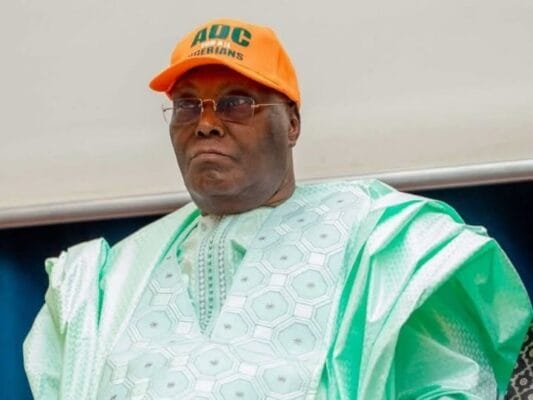
Former Vice President and African Democratic Congress (ADC) presidential candidate, Atiku Abubakar, has accused the President Bola Tinubu administration of masking economic hardship with favourable macroeconomic statistics, insisting that the country’s problem is not borrowing but wasteful spending and poor fiscal management.
In a statement issued on Monday by his Senior Special Assistant on Public Communication, Phrank Shaibu, Atiku said the Presidency’s recent defence of Tinubu’s economic policies failed to address the worsening living conditions of ordinary Nigerians.
He argued that while governments around the world borrow to finance development, the critical issue is whether such loans translate into improved infrastructure, jobs, public services and better living standards.
“No serious economist argues that borrowing is inherently wrong. Nations borrow. The real question is this: what has Nigeria obtained in return for the unprecedented debts accumulated under this administration?” Atiku said.
Gumi: Clerics who join politics better than those praying for politicians
2027: Makinde, Fayemi, Oyinlola Meet Obasanjo
The former vice president said Nigerians continue to grapple with unreliable electricity, worsening insecurity, unemployment, declining purchasing power and a severe cost-of-living crisis despite the government’s claims of improved revenues and debt sustainability.
He questioned why the Federal Government continued to accumulate fresh debt despite celebrating higher revenues from fuel subsidy removal, improved tax collection and increased debt-servicing capacity.
“If revenue has improved so dramatically; if subsidy has been removed; if tax collection has increased; and if debt servicing has supposedly become more manageable, why does this administration continue to borrow at record levels?” he asked.
Atiku also faulted the Presidency’s reliance on gross domestic product (GDP) growth as evidence of economic progress, saying the figures did not reflect the realities faced by millions of Nigerians.
According to him, economic reforms should be judged by improvements in household welfare rather than statistical indicators.
He cited findings from the International Monetary Fund (IMF), which estimated that 63 per cent of Nigerians now live below the national poverty line while about 27 million people faced food insecurity in late 2025.
“Governments are not elected to improve spreadsheets. They are elected to improve the lives of their people,” he said, adding that Nigerians “cannot eat GDP” or pay school fees with macroeconomic statistics.
The ADC chieftain further challenged the Federal Government to account for the benefits of fuel subsidy removal, noting that Nigerians were promised improved investment in infrastructure, healthcare, education and social protection but had instead witnessed record fuel prices, soaring transport costs and worsening inflation.
He also questioned the transparency of crude-backed financing arrangements, saying Nigerians deserved to know how much of the country’s future oil earnings had already been committed under such agreements and what projects the funds were financing.
On taxation, Atiku warned that increasing government revenue at the expense of struggling businesses could not be described as progressive reform.
He maintained that manufacturers were battling rising energy costs, multiple taxes and weak consumer demand, making it difficult for businesses to survive.
The former vice president also dismissed the Presidency’s continued reference to previous administrations as an excuse for current economic challenges, saying President Tinubu had been in office for more than three years and should now be judged by his own record.
He recalled that the administration of former President Olusegun Obasanjo, in which he served as vice president, implemented reforms that secured Paris Club debt relief, consolidated the banking sector and liberalised telecommunications, among other achievements.
Atiku further cited figures from the Manufacturers Association of Nigeria (MAN), claiming that 767 manufacturing firms had shut down while another 335 were in distress, with manufacturers holding about ₦2.14 trillion worth of unsold goods due to weak consumer purchasing power.
He said the figures reflected an economy where factories were shutting down despite government claims of recovery.
“The true verdict on this administration’s economic policies is not written by government spokespersons. It is written in the silent factories, the abandoned production lines, the shuttered warehouses, the unemployed workers and the empty pockets of millions of Nigerians,” he said.
News Credit to our media partner DailyTrust Home .