
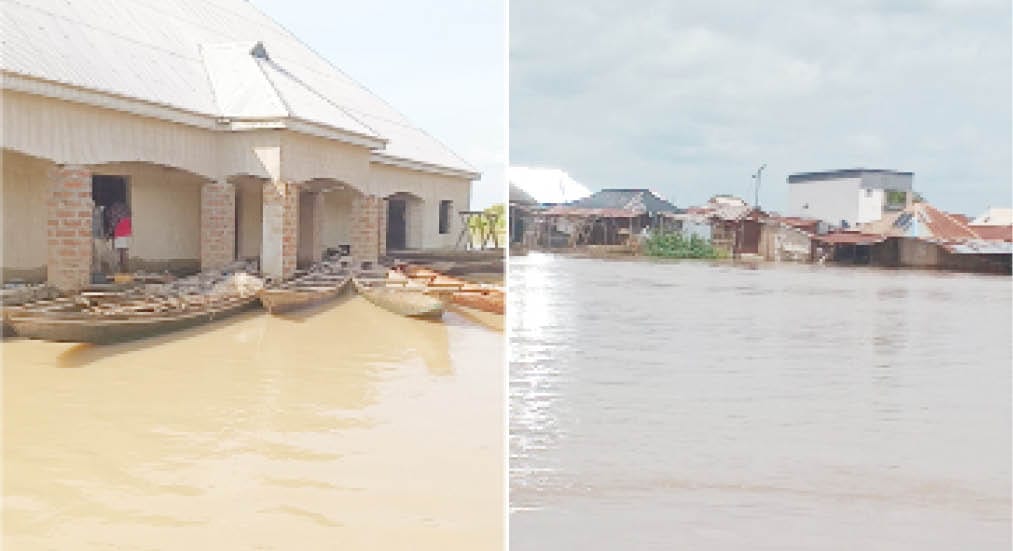
A severe flood disaster has claimed two lives and left 18 communities completely submerged across parts of Nasarawa State.
Some of the affected villages are Kwatan Bala, Olegokeme, Obendo, Achepe, Olegokpa, Ijiwo, Olegabgulu, Otiya-Gekye, Otiya-Giso, Odagede, Anagoga and Otariga, all under Rukubi and Akpanaja Wards of Doma Local Government Area of the state.
The flood, which residents described as massive, displaced thousands of people, destroyed several buildings, farmlands and property worth millions of naira.
Residents of the affected communities who narrated their ordeals said the disaster started about two weeks ago, when water volume from the River Benue increased and gradually entered farms and homes.
A resident of Obendo village, Mr Joel Daniel Onuminya, said Obendo is among the communities badly hit by the flood, adding that so much was lost by residents as crops that were about to be harvested were submerged, leaving many families unable to feed.
He said the flood also affected some buildings, forcing some people to renovate their houses, while others had to relocate temporarily.
Onuminya noted that though the water has started subsiding and some people have started returning to their homes, the damage was enormous.
When asked if such flooding is experienced every year, he said it is not a yearly occurrence, but depends on the opening of the Lagdo Dam in Cameroon and heavy rainfall.
He recalled that the community experienced a similar level of destruction in 2012, adding that the current flood, though not as massive as that of 2012, has caused serious damage, including landslides that swept houses into the water.
Appealing to the government, Onuminya said the affected communities need urgent assistance as many people can no longer feed their families, having lost their crops which they rely on for livelihood and for paying their children’s school fees.
Also, a resident of Otiya village, Mr Ogiri Philip Usman, said the flood destroyed a lot of property in his community, though the water is now receding.
He said the disaster affected mainly houses and farming products, forcing some residents, especially women, to leave the village for safer places.
According to him, as the water is getting back to normal, some of the displaced residents have started returning to their houses.
Usman clarified that schools, hospitals and other public facilities were also destroyed, saying houses and farmlands were badly affected.
He appealed to the government to come to the aid of residents of Otiya, adding that whatever the government does will be appreciated.
He said the community will be grateful for any assistance to help them recover from the losses incurred as a result of the flood.
Similarly, a resident of Ijiwo, Mr Sunday Ijiwo, said the flood had submerged communities for about two weeks, destroying houses and displacing residents.
He listed other affected settlements as Ebendo, Omi, Opa, Jigo, Oganlu, Otarika, Otiake and Otiaso.
According to him, displaced residents had sought refuge on higher ground and in other safer locations within the area.
Ijiwo said the communities experienced flooding almost every year around this period, but described this year’s incident as worse than previous ones.
He appealed to the government to provide a permanent relocation site for residents, as well as relief materials, including food, clothing and building supplies.
Over 4,000 displaced
Meanwhile, the Director-General of the Nasarawa State Emergency Management Agency (NASEMA), Benjamin Akwash, said more than 4,000 people had been displaced and that the agency was procuring relief materials for distribution to the victims.
The DG disclosed this during an interview after leading a delegation on an assessment visit to the affected communities.
He said the assessment followed a complaint by the member representing Doma South Constituency in the Nasarawa State House of Assembly, Hon. Musa Abubakar Ekye, to Governor Abdullahi Sule, who directed the Ministry of Humanitarian Affairs, NGOs and Disaster Management and NASEMA to assess the extent of the damage.
The delegation travelled by road to Makurdi, Benue State, before using a boat to reach the affected communities because flooding had submerged the road linking Doma to the area.
The NASEMA director-general described the situation as devastating, saying hundreds of houses had been submerged, leaving residents without adequate shelter, livelihoods and access to potable water.
He said the water had reached window level in some communities, while many houses were at risk of collapse.
He listed Ojoo and Ifia among the communities visited, but said the number of affected communities was estimated at between 11 and 12.
The official said the Ministry of Humanitarian Affairs would provide food items, while NASEMA would supply non-food items, including mattresses, blankets, mosquito nets, cement, roofing sheets and other building materials.
He said the agency had received a flood alert from the Nigerian Meteorological Agency (NiMet) before the rainy season, warning that Toto, Nasarawa and Doma local government areas were at risk of flooding.
According to him, the agency sensitised residents of riverine communities following the warning. He added that concerns over a possible release of water from the Lagdo Dam could further worsen the situation.
He said the affected communities could currently be reached from Makurdi by boat, as the road from Doma remained impassable.
‘No affected person will be left behind’
The Nasarawa State Government has assured residents affected by the flooding that no one would be left behind in its response to the disaster.
The Commissioner for Information, Culture and Tourism, Dr Nawani Aboki, confirmed the two deaths during a press briefing in Lafia, describing the flooding as a major humanitarian crisis.
He said Governor Sule had directed the DG of the State Emergency Management Agency to visit the affected communities and prepare a report to guide the government’s response.
Aboki said he had also visited the communities with the local government chairman to sympathise with residents.
He disclosed that the bodies of the two deceased persons were at a mortuary in Nasarawa Local Government Area, with burial arrangements expected to be made during the week.
The commissioner said displaced residents were taking refuge in communities on higher ground, with more than eight communities reportedly gathered in Agwama alone. He added that four to five communities had clustered together in Loko and other locations, placing additional pressure on their host communities.
He urged residents of low-lying areas to move to higher ground and heed advisories from the state government, the National Emergency Management Agency (NEMA) and NiMet.
Aboki also advised displaced residents not to return home until the floodwaters had receded completely, warning that further water releases from the Lagdo Dam remained a concern.
He said the government was working to provide relief supplies and prevent disease outbreaks in the affected areas.
The Commissioner for Humanitarian Affairs, NGOs and Disaster Management, Hon. Muhammad Baba Shehu, said his ministry was mobilising relief and other support for affected communities in the Ekye Development Area, where more than 11 communities along the River Benue had also been submerged.
He said the ministry was working with non-governmental organisations and development partners to provide shelter and livelihood support to flood victims, internally displaced persons and other vulnerable groups.
What You Should Know
Massive flooding in Nasarawa State’s Doma Local Government Area has displaced over 4,000 people, destroyed farmlands, and washed away houses. Residents report that the disaster began when water levels from the River Benue rose significantly, exacerbated by heavy rainfall.
- Positive Impact: The state government has mobilized the Nasarawa State Emergency Management Agency (NASEMA) and the Ministry of Humanitarian Affairs to deliver urgent food and non-food relief items, ensuring affected residents receive necessary support.
- Potential Concerns: The loss of harvested crops threatens food security and livelihoods in the affected farming communities, while impassable roads and potential water releases from the Lagdo Dam pose ongoing risks to displaced families trying to return home.