Five external political organizations fueled by substantial dark money contributions have surpassed the $1 billion spending mark for the United States midterm elections, establishing unprecedented spending records in an already costly political race.
An analysis of federal data by AFP showed that the five groups, known as super political action committees (super PACs), accounted for nearly a third of all non-party spending in the election cycle as of October 25.
With just over a week remaining before election day, the figures highlight the growing influence of wealthy donors and outside organisations in US election campaigns.
Three of the five groups are aligned with Republicans, while about two-thirds of the combined spending is expected to benefit the Republican Party, also known as the GOP.
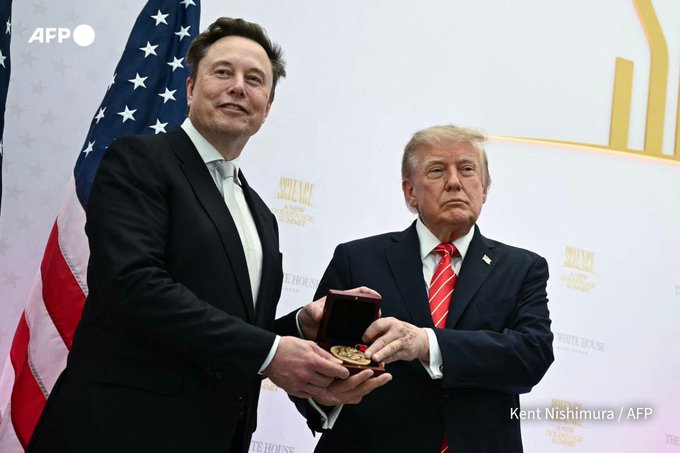
Among the major contributors is billionaire Elon Musk, a key ally of President Donald Trump, who has channelled nearly $450 million into Republican groups.
Musk’s contributions include funding for the Senate Leadership Fund, identified as the largest of the five super PACs.
Meanwhile, Democrats have a fundraising edge when it comes to direct donations to candidates’ campaigns and to the party’s national committees.
Democratic candidates in competitive Senate and House races have consistently outraised their Republican counterparts.
That suggests smaller donors in the Democratic base are highly motivated.
But tortuous US election laws impose strict caps on how much individuals can give, while there is no limit — or really any control at all — on how much super PAC groups can throw at candidates.
– Unlimited contributions –
The five giant spenders in this cycle are technically a mix of super PACs and hybrid PACs, entities that didn’t even exist before 2010.
They grew out of a Supreme Court ruling, known as Citizens United, which held that the government cannot limit political spending by corporations, unions and other groups if they spend it independently of candidates.
A lower court decision ruled that these organizations could also raise an unlimited amount of money from donors.
The result was that big donors can funnel vast sums of money to try and influence elections and remain anonymous by donating through secondary organizations.
In contrast, direct contributions to a candidate’s official campaign are limited to a mere $3,500, and donations to national party committees have a cap of $44,300.
The PAC spending sprees have surged ever higher during the Trump era, with Musk’s mega-million donations encapsulating the new reality of pay-to-play politics.
But money alone is not enough, says Jen Heerwig, an associate professor of Sociology at SUNY-Stony Brook university.
“What we’ve seen is that even in races where there’s hundreds of millions of super PAC dollars being spent, it’s unclear to me that that’s going to buy the outcome when you don’t have the grassroots kind of enthusiasm or support for the candidate in that particular jurisdiction.”
– Targeted spending –
Across the nation, super PACs have put far more of their money into Senate contests and spent it largely on attack ads.
The Texas Senate election tops the list in terms of expenditure. Democrat James Talarico has faced more than $200 million in opposition from outside spending groups as he attempts to become the first Democrat to win a Senate race in Texas since 1988.
Second is Ohio’s special Senate election, where Democrat Sherrod Brown has also faced extensive outside spending against him — nearly $170 million — as he tries to return to the Senate.
This high volume of attack ads is typical, says Heerwig, as super PACs tend to mainly produce negative media content, doing the “dirty work” of attacking the opponents of their favored candidates.
Even if it doesn’t guarantee victory, the constant negativity “is a problem in that it feeds into our sense of disillusionment and low confidence [and] trust in the institutions that are governing us,” Heerwig said.
What You Should Know
Political spending in the United States continues to reach historic heights, driven by the massive influence of super political action committees (super PACs) and wealthy donors like Elon Musk, who can contribute unlimited funds through secondary organizations. While the Supreme Court’s Citizens United ruling protects independent political spending by corporations and wealthy individuals, critics point out that this influx of money often fuels relentless attack ads and deepens public cynicism toward governing institutions.
- Positive Impact: Supporters argue that high campaign funding allows for robust voter outreach, political discourse, and widespread civic engagement ahead of crucial elections.
- Potential Concerns: The dominance of mega-donors and dark money can overshadow everyday grassroots voters, flood the media with negative attack ads, and foster public distrust in the democratic process.