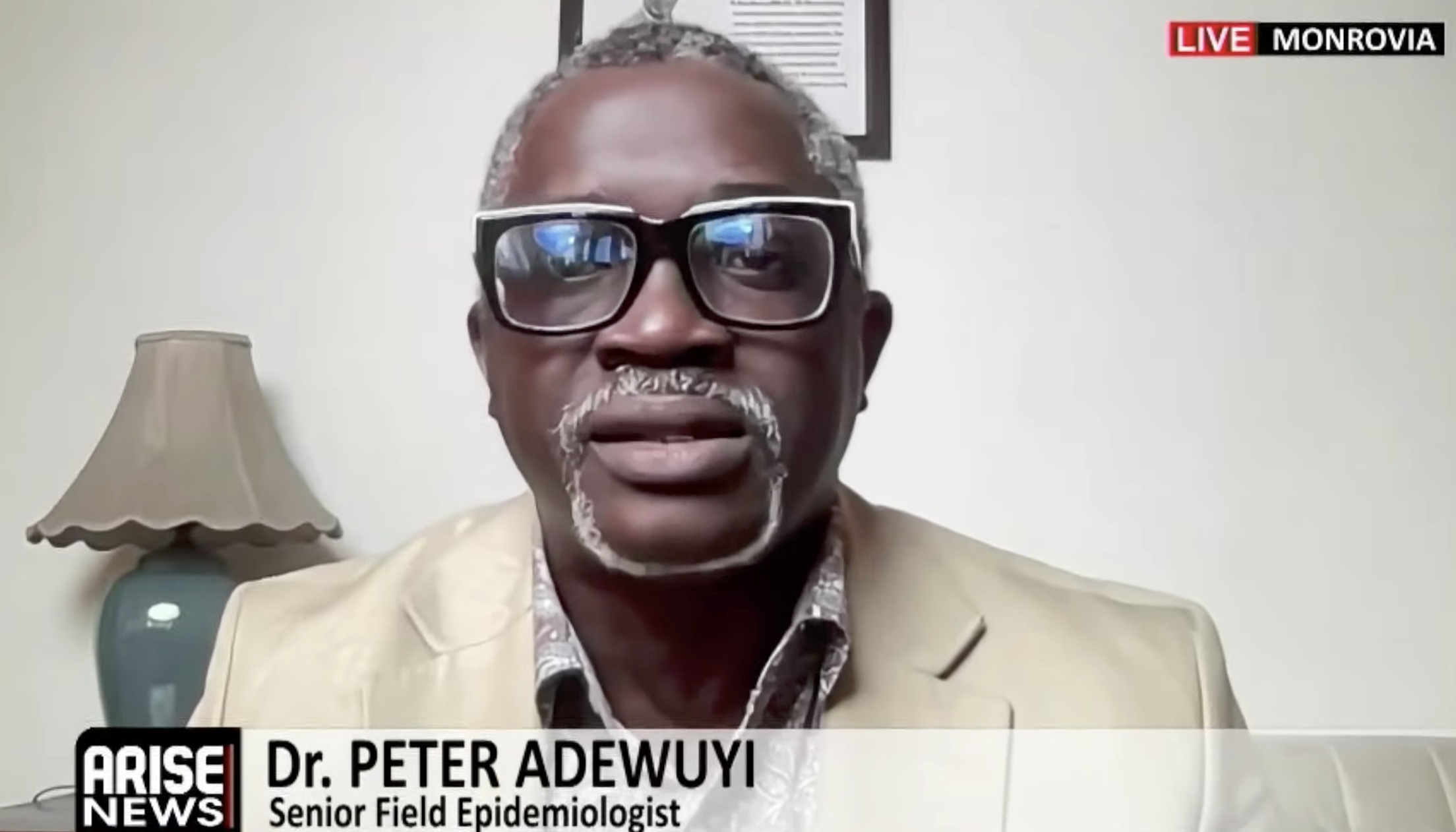
Dr. Peter Adewuyi, a senior field epidemiologist, has urged the Nigerian government to empower the nation’s trained specialists to spearhead efforts in containing the confirmed Ebola case and halting further spread.
Adewuyi, who led contact tracing during Nigeria’s 2014 Ebola outbreak, said the country had enough trained personnel to support the response without relying on foreign experts.
“We have about 500 epidemiologists in the country and the government should just allow the epidemiologists to do their work.”
Speaking during an interview on ARISE News on Thursday, Adewuyi said the Nigeria Centre for Disease Control and Prevention (NCDC) had started the response early but noted that the detection of the latest case took longer than the recommended timeframe.
“We have this thing called 717 which is a key performance indicator that we use in surveillance to be able to know whether we are detecting early. We are supposed to detect within seven days, report within a day and then response within seven days. Response is okay, reporting is okay, but the detection took for this about eight to nine days and that is the fear as far as the response that we are given right now,” he said.
Adewuyi, who led contact tracing during Nigeria’s 2014 Ebola outbreak, said the country did not need foreign epidemiologists to manage the response.
“Nigeria does not need people to come from outside,” he said.
He also said the African Field Epidemiology Network (AFENET) was supporting the NCDC to deploy more epidemiologists to the field.
“I think, for example now, AFINET is supporting the NCDC to get more epidemiologists on ground.”
He explained that Nigeria already had a surveillance system designed to track diseases from health facilities and local government areas to state and national levels.
“The IDSR is Integrated Disease Surveillance and Response System whereby we are able to track diseases in all the local governments of Nigeria, starting from the government to the health facilities to the local government to the state and then to national. This is part of the system that works,” he said.
The epidemiologist also stressed the need to identify everyone who may have come into contact with the patient before her diagnosis, including people who worked in the hospitals where she received treatment.
“So in this case, all the people that treated this person from day one till the time she was diagnosed, all of these people are contacts. Whether the person that came to sweep the room, whether the person that came to make the bed, every one of them,” he said.
Adewuyi said the number of identified contacts could rise as investigations continued, noting that people who might have been exposed needed to provide accurate information to health authorities.
What You Should Know
A senior field epidemiologist who managed contact tracing during the 2014 Ebola crisis has advised the government that Nigeria possesses around 500 qualified professionals capable of handling disease outbreaks independently without foreign assistance.
- Positive Impact: Utilizing local experts boosts confidence in home-grown medical systems and guarantees that experienced personnel familiar with regional surveillance frameworks are deployed immediately.
- Potential Concerns: A slight delay in detecting the latest case beyond recommended global timeframes highlights vulnerability, emphasizing the need for stricter surveillance and rapid response protocols across all health facilities.