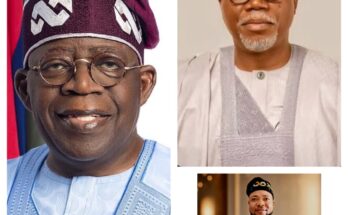
The leaders of the Nigeria Labour Congress (NLC) and the Trade Union Congress (TUC) are currently at loggerheads over which group has the power to discuss wages and benefits for Nigerian workers with the Federal Government.
The disagreement has also exposed divisions within the Joint National Public Service Negotiating Council (JNPSNC), following a move by three registered public service unions to distance themselves from a statement issued in the council’s name.
The unions insisted that no individual or group could speak on behalf of workers without their authorisation, declaring that they neither participated in nor endorsed the disputed statement.
The controversy followed the Federal Government’s approval of a six-month palliative for workers across all levels.
Speaking separately on Channels Television’s The Morning Brief on Monday, NLC President, Joe Ajaero, maintained that his union had the authority to negotiate independently with the government, citing the International Labour Organisation (ILO) principle of the most representative workers’ organisation.
According to Ajaero, the TUC could participate in negotiations alongside the NLC but the latter did not require the participation of the former to engage the government.
“TUC can negotiate along with NLC, but NLC can negotiate alone based on the principle of most workers’ representatives of the ILO,” he said.
Ajaero also explained how the N70,000 transport allowance intervention emerged, saying the government approached the labour union after it issued an ultimatum over workers’ demands.
“We gave the government an ultimatum; we were supposed to start an action. The government asked for four days to meet with us, and we met, and they resumed sitting after four days. After the meeting, the N70,000 allowance came up,” he stated.
However, TUC President, Festus Osifo, faulted the negotiations that produced the N70,000 agreement, describing the process as an aberration because his union was not involved.
Osifo challenged Ajaero to produce the ILO regulation authorising one labour centre to negotiate on behalf of another.
He also questioned the legitimacy of the meeting that produced the transport allowance agreement, arguing that members of the JNPSNC were not represented and that the outcome did not reflect a majority consensus.
Meanwhile, three public service unions have rejected the statement issued in the name of the JNPSNC, insisting that they were neither consulted nor invited to any meeting where the issues raised were discussed.
The position was contained in a joint statement signed by the President of the Senior Staff Association of Statutory Corporations and Government-Owned Companies (SSASCGOC), Kayode Alakija; President of the Senior Staff Association of Universities, Teaching Hospitals, Research Institutes and Associated Institutions (SSAUTHRIAI), John Alli; and President of the Nigerian Union of Allied Health Professionals (NUAHP), Dr Kamal Ibrahim.
The unions said the disputed statement could not be regarded as the collective position of public service trade unions.
“The statement is therefore unauthorised and cannot be passed off as the collective position of public service trade unions.
“We did not participate in its preparation, endorse its contents or authorise anyone to speak on our behalf,” the statement said.
They further disclosed that the Vice Chairman of the JNPSNC, representing the Association of Senior Civil Servants of Nigeria (ASCSN), was also not consulted before the statement was issued.
Ajaero, however, maintained that discussions on a new minimum wage could only commence after the Federal Government constituted a negotiation committee, stressing that such negotiations required broader consultations involving labour leaders, government representatives and employers
What You Should Know
This disagreement centers on whether the NLC can negotiate on behalf of all workers without the TUC being in the room. NLC President Joe Ajaero argues that international rules allow the most representative union to talk to the government alone, while TUC President Festus Osifo insists that excluding them makes the agreements invalid.
- Positive Impact: The competition between the two labour centers could encourage both to be more aggressive in demanding better welfare packages for workers to prove their effectiveness.
- Potential Concerns: A divided labour movement is often weaker. If the unions cannot agree on a single front, the government may find it easier to push through policies that workers dislike or delay the implementation of a new national minimum wage.