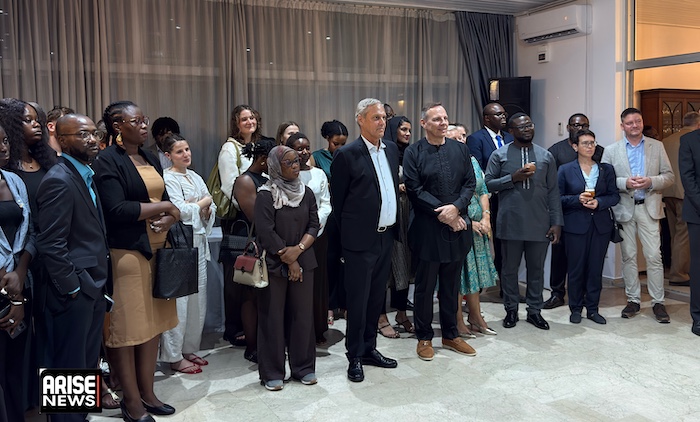
As a visiting German parliamentary delegation meets with local institutions and professionals, Germany aims to broaden its academic ties with Nigeria beyond standard scholarships, pushing for deeper business networks, private investments, and technical training programs.
Christoph Naser, a member of the delegation, said the visit provides an opportunity to connect with Nigerian businesses, financial institutions and young professionals developing ideas for new ventures.
“We get in touch with different kinds of companies, banks, or, for example, young professionals starting their own business, having great ideas for starting their businesses,” Naser said.
He said the delegation hopes to build relationships that support closer economic and institutional cooperation between both countries.
“We want to do, to get in touch with interesting people, with inspiring people, and to make new connections between our countries in order to deepen our economic friendship and our cooperation,” he said.
Naser added that bringing universities, colleges, businesses and cultural institutions together could create opportunities for both countries, particularly through economic and scientific exchange and engagement with Nigeria’s young population.
On academic cooperation, Gerald Heusing, a German Academic Exchange Service (DAAD) lecturer at the University of Lagos, said partnerships between Nigerian and German institutions should continue beyond individual scholarships.
He said Nigerian graduates who study in Germany could go on to become professors, heads of departments, deans and university vice-chancellors, creating opportunities to sustain and deepen academic collaboration.
“We want them to continue co-operation, because they will also grow, they did their PhD, maybe they will become a professor, the head of a department, maybe even the dean of a faculty or the vice-chancellor of a university, and we want them to continue this co-operation and take it to higher levels,” Heusing said.
DAAD supports about a dozen partnerships between Nigerian and German universities, including a collaboration between the University of Lagos and the Free University of Berlin focused on urban development.
Heusing said nearly 3,000 scholarships were awarded to Nigerians last year. The DAAD alumni association also supports workshops, outreach activities and advice for prospective applicants.
Daniel Krull, another member of the delegation, said Germany also wants to strengthen the relationship between private-sector investment and the objectives of its development assistance.
“What we are aiming for is we would like to increase the linkages between investment of private companies from Germany with the impact we try to achieve with our development aid money,” Krull said.
He cited Nigeria’s electricity challenges and Siemens Energy’s involvement in the Presidential Power Initiative as areas where investment and development cooperation can work together.
Krull said delivering electricity projects also requires a skilled workforce, including properly trained electricians. He pointed to a school in Abeokuta co-funded by Germany to train electricians for the Siemens Energy project, the Nigerian government initiative and other Nigerian companies.
The delegation’s engagements highlight Germany’s interest in building longer-term cooperation with Nigeria through business relationships, skills development and academic partnerships that extend beyond individual projects and scholarships.
What You Should Know
A visiting delegation of German lawmakers is exploring ways to move past traditional scholarship programs and build long-lasting economic and educational bridges with Nigeria. The initiative focuses on connecting German companies and investors with Nigerian entrepreneurs, financial institutions, and universities, while also supporting technical training linked to major infrastructure projects like the Presidential Power Initiative.
- Positive Impact: Nigerian students, young entrepreneurs, and professionals stand to gain enhanced access to long-term mentorship, direct investments, and specialized technical training that can boost local job readiness.
- Potential Concerns: The success of these expanded partnerships heavily depends on overcoming local infrastructural challenges, such as consistent electricity supply and regulatory ease for foreign investors.