Six years following the #EndSARS demonstrations against police brutality, the mother of deceased journalist Pelumi Onifade continues her relentless search for her son’s body, amidst ongoing uncertainty surrounding his death.
Onifade, a 20-year-old journalist with Gboah TV, went missing in October 2020 while covering the protests in Lagos.
Accounts of the incident alleged that he was shot and taken away by operatives of the Lagos State Police Task Force during an operation to disperse protesters.
His disappearance triggered a prolonged search by his family, who have continued to seek answers about his death and the whereabouts of his remains.
Speaking with Daily Trust on the telephone on Tuesday, his mother, Bosede Onifade, said she would not stop demanding justice for her son.
“Don’t I have a right to demand my son’s remains, even if they say he is dead? What do I tell my God? Do I tell Him that I cannot account for the son He gave me?” she asked.
She said the pain of losing her son was compounded by the fact that he had yet to be buried six years after his disappearance.
“I feel so bad every day about his death and the fact that he has not been buried. People should fear God. I know I don’t know people, but I have God. The matter is still in court.
“I always remember his promise to make the family proud. We all looked up to him as the future of the family, but his life was cut short, and we couldn’t even get his corpse six years after,” she said.
The search for Onifade’s remains led his family to an unidentified body at a government hospital mortuary in Ikorodu, Lagos State.
The body, registered under identification number 1385, became central to efforts to establish what happened to the missing journalist.
In 2024, the Federal High Court in Lagos ordered an investigation into the circumstances surrounding his death following a suit filed by Media Rights Agenda.
Subsequent legal proceedings, including a coroner’s inquest, sought to establish the identity of the body and determine the circumstances of his death.
Reports in 2026 indicated that DNA testing had confirmed that the remains belonged to Onifade. However, his family’s demand for the release of the remains and accountability for his death has remained unresolved.
His case reflects the pain of families still seeking answers about relatives who died or went missing during the #EndSARS protests and the events surrounding the crackdown on demonstrators.
The #EndSARS protests began in October 2020, following years of complaints against the Special Anti-Robbery Squad (SARS), which was accused of harassment, extortion, unlawful arrests, torture, profiling and extrajudicial killings.
Thousands of young Nigerians participated in demonstrations demanding the disbandment of SARS, police reforms and better governance.
The protests drew national and international attention following the shooting of demonstrators at the Lekki tollgate in Lagos on October 20, 2020.
The Federal Government denied that soldiers had shot at protesters. Lai Mohammed, the then Minister of Information and Culture, described reports of a massacre as a “phantom massacre”.
The Lagos State Judicial Panel of Inquiry, which investigated the incident, found that protesters were shot at, injured and killed.
The state government later rejected key parts of the panel’s findings, including aspects of its conclusions on casualties.
Following the protests, police authorities disbanded SARS and established the Special Weapons and Tactics (SWAT) team to handle armed robbery and other violent crimes while addressing concerns about the conduct of the disbanded unit.
However, the move generated controversy, with protesters questioning whether the new unit would bring genuine reforms or simply continue the practices associated with SARS under a different name.
A 2023 assessment of the #EndSARS movement noted that protesters remained suspicious of the replacement of SARS with SWAT, fearing that the same abuses could continue.
Human rights lawyer Onyeisi Chiemeke said there was insufficient publicly available, independently verified evidence to determine whether SWAT had significantly reduced police brutality or improved public trust.
He, however, said cases of police brutality and harassment of young Nigerians persisted.
“If the creation of SWAT had addressed the issue, then there would have been no need for the creation of multiple checkpoints,” he said.
Chiemeke said the continued controversy over police conduct showed that accountability could not be achieved simply by replacing one tactical unit with another.
He also cited Human Rights Watch’s findings that it had not been able to establish whether security personnel had been arrested or tried for their roles in the crackdown on protesters.
The organisation also documented accounts of protesters who sustained gunshot injuries.
“The experience of the #EndSARS protests demonstrated that public confidence in the police depends not only on the ability to arrest suspects and prevent violent crime but also on transparency, professional conduct and credible consequences for misconduct,” he added.
Police fire tear gas to disperse gathering at Lekki toll gate
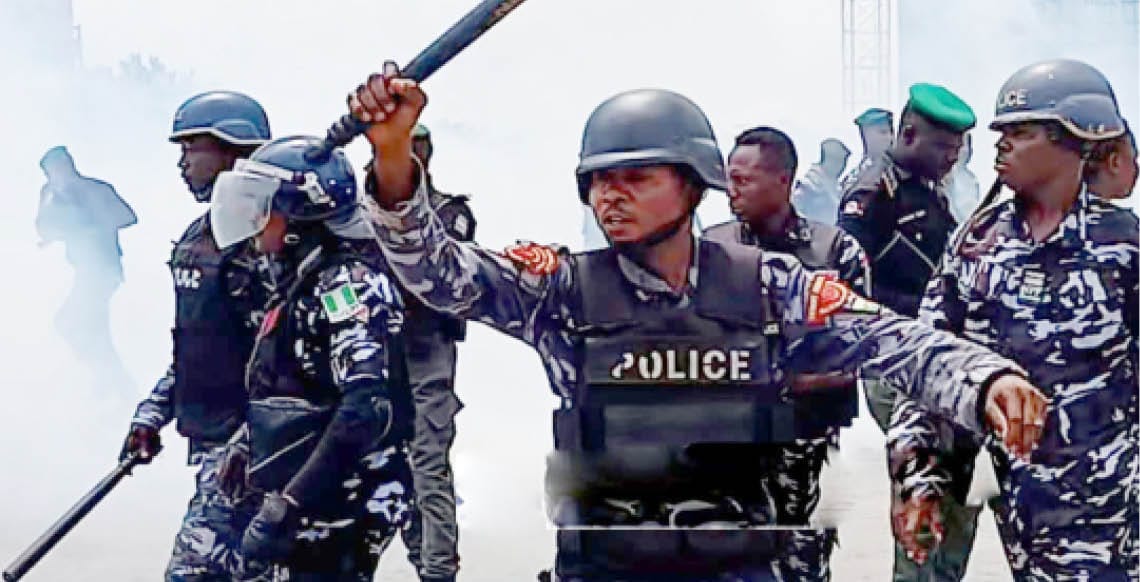
Tension broke out on Tuesday at the Lekki Toll Gate in Lagos as police fired tear gas to disperse activists and concerned Nigerians who gathered to commemorate the sixth anniversary of the #EndSARS protest.
The gathering was organised to honour those who lost their lives and remember the demonstration against police brutality.
The protesters were forced to flee as tear gas filled the area, disrupting the planned commemoration.
Among those who gathered at the toll gate were the Lagos State governorship candidates of the Nigeria Democratic Congress (NDC), Funso Doherty, and the African Democratic Congress (ADC), Gbadebo Rhodes-Vivour.
Despite the disruption, the activists vowed to continue the struggle for justice and police reforms that inspired the #EndSARS protest, while keeping alive the memory of those who died.
This is not the first time police have fired tear gas to disperse people gathered at the toll gate for commemoration.
In October 2021, police fired tear gas during a memorial procession organised by youths and celebrities to honour victims of police brutality.
The then Lagos Commissioner of Police, Hakeem Odumosu, said the officers were dispersing people he described as “miscreants”, rather than participants in the procession.
In 2024, police again fired tear gas to disperse protesters marking the fourth anniversary.
The protesters had called for the full implementation of recommendations made by judicial panels established after the 2020 demonstrations.
The police said they acted after the protesters refused to disperse.
What You Should Know
Six years after the historic #EndSARS protests, the family of a young journalist who went missing while covering the demonstrations is still fighting to retrieve his remains and secure proper closure. Despite court orders and DNA tests confirming his identity, the family’s quest for justice and the release of his body remains unresolved, highlighting ongoing struggles for accountability.
- Positive Impact: Brings renewed public awareness and advocacy to the unresolved cases of missing persons and victims from the #EndSARS protests.
- Potential Concerns: Underscores the persistent challenges in achieving accountability and justice for victims of police brutality and security crackdowns in Nigeria.