Violence erupted between demonstrators and law enforcement officers in Barcelona after massive crowds mobilized for Spain’s inaugural general strike in over a decade, which was organized by major labor unions to protest soaring living expenses and housing crises.
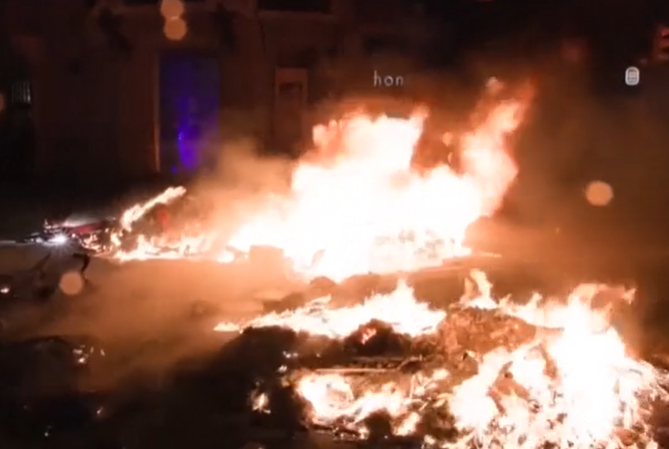
Some 120,000 people joined a demonstration in the capital Madrid and more than 50,000 turned out in Barcelona, where footage showed masked men setting fire to rubbish bins and smashing shop windows as police fired tear gas.
Transport and other public services across Spain faced serious disruption.
The head of the big UGT labour union, Pepe Álvarez, said the strike was a success with “massive” participation, while Unai Sordo of the CC OO union said turnout was “very significant.”
There was a heavy police presence in the centre of Barcelona on Wednesday evening, with officers wearing helmets and riot shields.
Some of the disturbances took place in the Passeig de Gràcia, close to the iconic Plaça de Catalunya in the centre of the city.
Small fires burned in the middle of the streets where the disturbances took place. Local media reported that a group of people fired fireworks towards police and looted shops including the Lego store. Protesters were also seen trying to enter the Apple Store.
Earlier in the day there was major disruption around Madrid and Barcelona, with traffic halted on several main roads.
The interior ministry said dozens of people were arrested for a variety of incidents and Spanish reports said estate agencies had seen attacks on their offices.
“We’ve completely brought the city to a standstill.,” a protester in Madrid told Reuters news agency, adding there was widespread support for the general strike. “Everyone’s out there, despite the rainy weather; everyone’s out on the streets.”
Another protester, 37-year-old teacher Olga Domingo, said she was protesting because the government “keep making cuts” and “the housing situation is outrageous. The current cost of living compared to wages is completely unsustainable”.
The strike was triggered by widespread protests over affordable housing and rising living costs, after the eviction of 87-year-old Maricarmen Abascal from a flat in Madrid where she had lived for seven decades. She died in hospital weeks later.
Rental prices in the capital have risen in recent years. The monthly cost of a 50 sq m apartment in Madrid was an average of €1,170 ($1,300; £1,000) in October, according to property portal Idealista, while Spain’s average gross monthly salary is about €2,460.
That amounts to nearly half the average gross salary, well above the 30% level of affordability often recommended by housing experts and public institutions.
Socialist Prime Minister Pedro Sánchez called snap elections last month after parliament failed to approve his plan for housing reform.
Not since 2012, under the conservative government of Mariano Rajoy, has Spain held general strikes.
And while previous strikes have been problematic for the government in power, this one is different. Sánchez and his ministers have even encouraged workers to down tools and demand affordable housing.
“Your eight-hour day. Your pension. Your public healthcare… These were collective conquests,” he wrote on social media, praising those who took part in previous strikes.
The conservative People’s Party (PP), by contrast, has accused the government of attempting to weaponise the strike for electoral gain.
PP leader Alberto Núñez Feijóo called the general strike “nonsense”, calling the unions “mafia” and “trash”. Feijoo’s party is leading in the polls and party spokesman Miguel Tellado accused the government of exploiting the strike to warn voters against allowing a right-wing government to be formed, which looks the most likely outcome of the 29 November election.
Sánchez told Spanish TV this week: “What is nonsense is to question the rights of workers to strike.”
Among those taking part in the general strike was Gonzalo Álvarez, 27, who was visiting different picket lines in central Madrid.
Although he works in sales, he has been volunteering for a housing union that tries to protect tenants and makes them aware of their rights.
The eviction of Maricarmen Abascal at the end of September “was the little fire” that sparked this protest, he told the BBC.
Álvarez knew the 87-year-old, who had faced a tripling of her rent under new landlords, and says he was deeply upset by her treatment.
He rents a small, one-bedroom flat with his girlfriend, a dental hygienist, in the city’s southern Arganzuela disrict. The couple pay €1,000 between them, which means each spends about half of their salary on housing, even before other bills.
“It’s absolutely crazy… with the food, with the electricity, with the water, with gas.”
He sees no way of getting on the property ladder: “You have to collect an insane amount of money to be able to buy a house. So with these salaries, it’s impossible.”
With current rent and purchase prices, he believes buying somewhere is “completely impossible”.
However, the vice-president of the CEOE, Spanish biggest business association, Miguel Garrido, criticised the strike, complaining that businesses had little to do with the price of housing.
“This is not a strike for labour-related reasons, but rather for political ones, and it is closely linked to the early calling of elections,” he said.
Demonstrations were planned for some of Spain’s biggest cities later in the day and the scale of support will be widely viewed as an indicator of public discontent ahead of the election.
Another reliable indicator of support for strikes is the level of demand for electricity with Spain’s industrial sector.
What You Should Know
Spain recently experienced its first general strike in 14 years, as over 100,000 citizens took to the streets in Madrid and Barcelona to protest unaffordable housing and rising living costs. The nationwide protest caused major disruptions in transportation and public services, accompanied by clashes with police, property damage, and dozens of arrests. The unrest was triggered by public outrage over soaring rental prices—which consume nearly half of the average worker’s salary—and the recent eviction and subsequent death of an 87-year-old tenant.
- Positive Impact: The massive turnout amplifies public pressure on the government to enact meaningful housing reforms and address cost-of-living challenges for ordinary citizens.
- Potential Concerns: The protests have led to violent street clashes, property damage, localized business disruptions, and political polarization ahead of the upcoming national elections.