Brazilian President Luiz Inácio Lula da Silva has warned world leaders against allowing geopolitical rivalries, armed conflicts and inflation to undermine global efforts to tackle climate change.
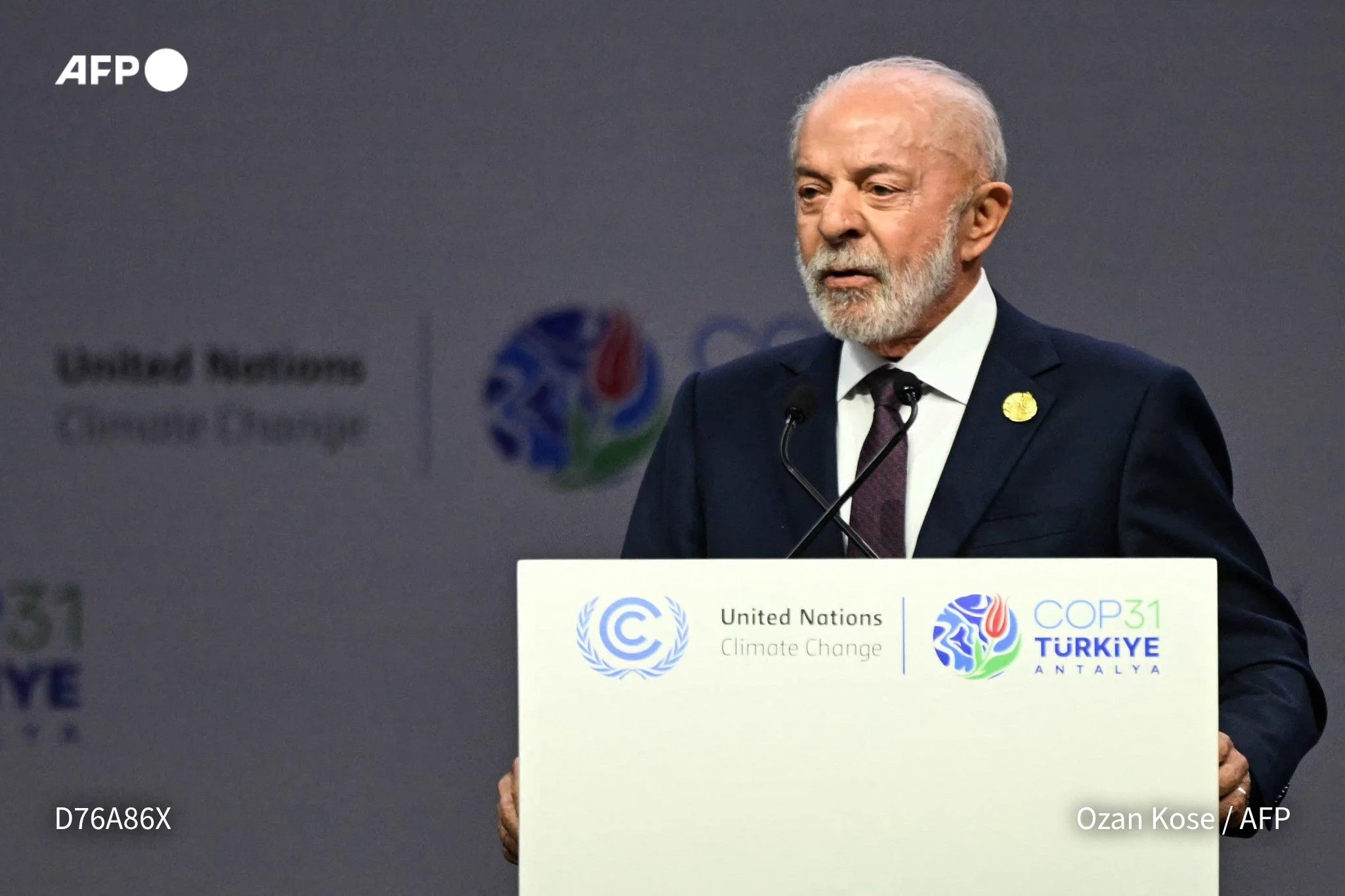
Addressing the opening session of the COP31 Leaders’ Summit in Antalya, southern Türkiye, on Wednesday, Lula said climate change had disappeared from discussions at major international forums, including the G7 and G20.
“Climate change disappeared from the speeches and documents of global leaders at the G7 and G20 meetings, forums that bring together the world’s biggest greenhouse gas emitters. This concern turned into silence,” he said.
The Brazilian leader criticised the growing focus on military spending and trade disputes at the expense of environmental protection and the future of younger generations.
“We started talking more about weapons and tariffs than the survival of future generations,” he said.
Lula warned that conflicts and inflation were making it increasingly difficult for governments to prioritise climate action, insisting that environmental protection must not become a casualty of global power struggles.
“The planet cannot be at the mercy of hegemonic struggles,” he added.
He also expressed concern over declining momentum since COP30, which was hosted by Brazil in Belém, arguing that the transition to clean energy was increasingly being portrayed by some countries as an obstacle to national security and economic prosperity. Lula pushes climate financing, fossil fuel transition The Brazilian president called on the joint COP31 leadership of Türkiye and Australia to incorporate three climate action roadmaps agreed in Belém into the next Global Stocktake.
The proposals include mobilising $1.3 trillion annually in climate financing, transitioning away from fossil fuels and ending deforestation.
He also disclosed that the Tropical Forest Forever Facility (TFFF) had secured support from dozens of countries and was approaching the capital threshold required to begin formal operations.
Lula urged more countries and partners to support the initiative, which is designed to provide long-term financing for tropical forest conservation.
On global emissions, he warned that existing national climate commitments put the world on course for a temperature rise of 2.8 degrees Celsius, significantly above the targets set under the Paris Agreement.
He backed initiatives to expand electrification, including the 35-by-35 pledge aimed at increasing electricity’s share of energy consumption to 35 per cent by 2035 while reducing waste. Brazil cites economic growth, Amazon conservation Lula presented Brazil’s economic performance and environmental policies as evidence that economic growth could go hand in hand with emissions reduction.
He said Brazil was on course to become the world’s eighth-largest economy while cutting emissions by 42 per cent compared with 2005 levels.
He also highlighted a 71 per cent reduction in deforestation in the Amazon between 2022 and 2026.
According to Lula, the reactivated Amazon Fund approved a record number of conservation projects over the past year, covering three-quarters of municipalities in the Amazon basin. Lula defends climate science, multilateral cooperation The Brazilian leader also warned against growing ideological attacks on climate science and multilateral diplomacy.
He criticised attempts by reactionary groups to undermine the work of the Intergovernmental Panel on Climate Change (IPCC), stressing the importance of scientific evidence in shaping environmental policies.
Lula argued that the United Nations climate framework remained essential because it provided member states with equal participation, unlike other international institutions where veto powers and financial influence could shape decisions.
Describing the environmental crisis as one rooted in global inequality, he urged industrialised nations to honour their climate financing commitments.
He further described the next climate summit, COP32, scheduled to hold in Africa, as an opportunity to mobilise resources and address the debt burdens limiting developing countries’ capacity to respond to climate change.
Lula commended Turkish President Recep Tayyip Erdoğan for hosting COP31 in Antalya, describing Türkiye’s position as a geographical and diplomatic crossroads as an opportunity to bridge divisions among nations.