My journey began with a quest to see ancient soldiers, but it ended with deep reflections on Nigeria’s untapped tourism potential.
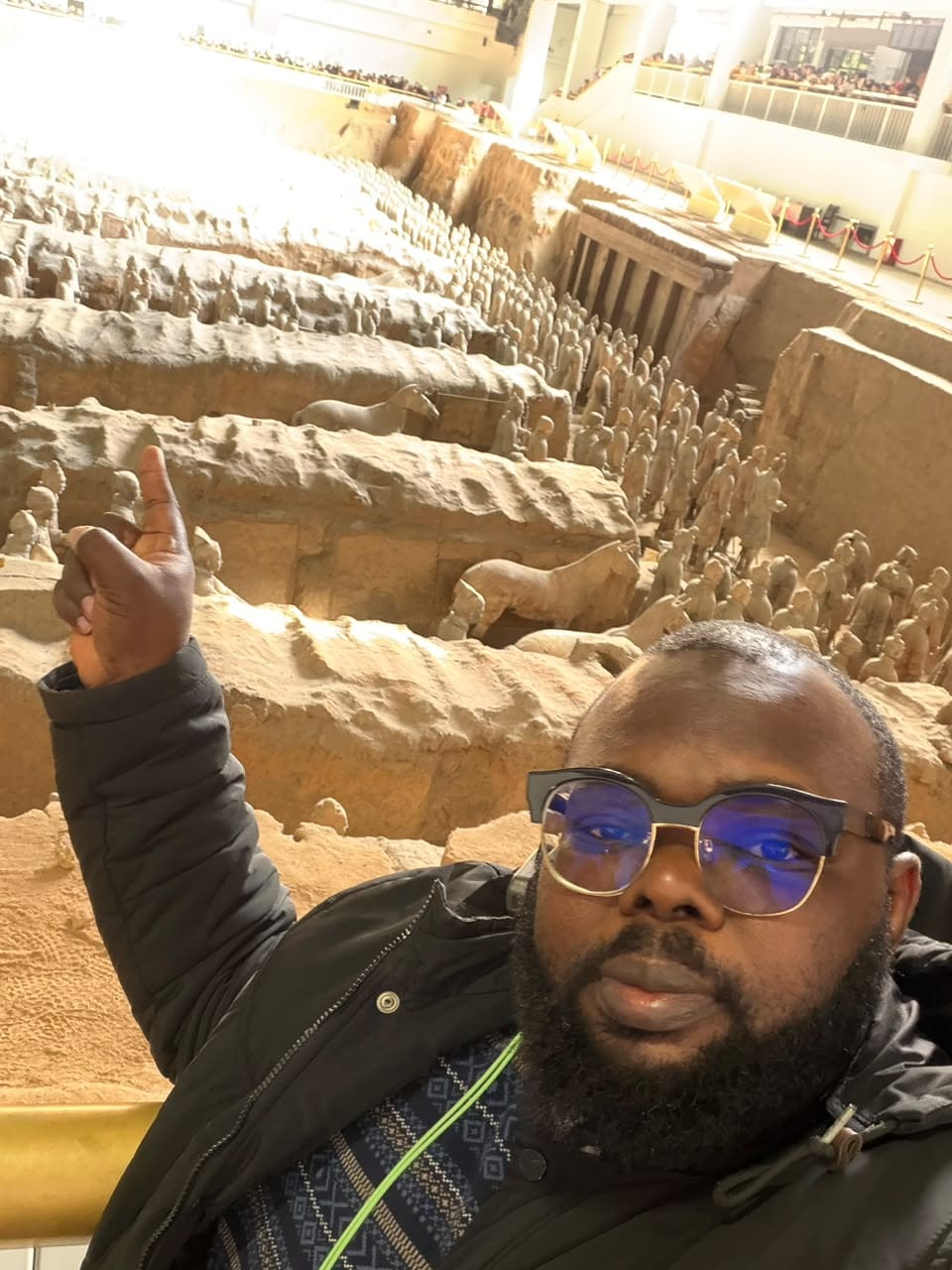
One of the things I was particularly looking forward to during my visit to China was seeing the famous Terracotta Warriors in Xi’an. I had read about them, seen pictures and, of course, watched films inspired by the mysteries of ancient China. But nothing quite prepares you for the experience of standing in front of thousands of life-sized soldiers who have been buried underground for more than 2,000 years.
And what an experience it was!
For anyone who has watched Hollywood’s The Mummy: Tomb of the Dragon Emperor, you may remember the mysterious army of clay soldiers that comes alive. Well, I finally got to see the real thing. Thankfully, none of them came alive while I was there! 😂
But standing in those enormous exhibition halls, surrounded by thousands of soldiers, horses and chariots arranged in military formation, I couldn’t help wondering what must have gone through the minds of the people who created this extraordinary army.
The story takes us back to around 221 BC, when Qin Shi Huang became the first emperor to unify China. Like many powerful rulers of his time, he was obsessed with immortality and the idea of continuing his reign beyond death.
His solution was to build an entire underground army to protect him in the afterlife.
Think about that! While some people prepare for retirement, this emperor was preparing for eternity, complete with his own military formation!
The scale of the project is difficult to comprehend. Thousands of life-sized clay soldiers, horses and chariots were painstakingly created. And what makes the discovery even more fascinating is that the soldiers are not identical. They have different facial features, hairstyles, uniforms and expressions. They look like real individuals, each with a distinct identity and military rank.
Then comes another remarkable twist.
For over two thousand years, this enormous army remained hidden beneath the earth until 1974, when some local farmers digging a well stumbled upon fragments of what would become one of the greatest archaeological discoveries in modern history.
Imagine going out to dig a well and discovering an entire army! I wonder what the conversation was like that evening when they returned home.
Today, the site is recognised globally as one of the greatest archaeological treasures in the world and is popularly described as the Eighth Wonder of the World. UNESCO designated the Mausoleum of the First Qin Emperor a World Heritage Site in 1987.
But beyond the fascinating history, what struck me most was what China has done with this discovery.
This is where the story becomes particularly interesting for Nigeria.
China has not simply uncovered an ancient treasure and left it to gather dust. It has invested in archaeological research, conservation, restoration, museum infrastructure, visitor facilities and tourism development.
The preservation work itself is remarkable. Some of the warriors originally had brightly painted surfaces, but exposure to the atmosphere caused much of the colour to deteriorate. This is why conservation experts have to work carefully to protect what remains.
In other words, these people understand that preserving history requires knowledge, patience, investment and a long-term commitment.
And they have turned that commitment into an extraordinary tourism opportunity.
The Terracotta Warriors Museum attracted more than 10 million visitors in 2025. Think about the economic activity generated by that number of visitors. Flights, hotels, restaurants, taxis, tour operators, souvenirs, local businesses and employment opportunities.
And the benefits do not end at the museum gates.
Xi’an has built a thriving tourism economy around its ancient city walls, historical sites, museums, cultural performances, traditional architecture and cuisine. The city reported tourism revenue of about 376 billion Chinese yuan in 2024.
Of course, that figure represents the wider city’s tourism economy, not the earnings of the Terracotta Warriors Museum alone. But it demonstrates the enormous economic possibilities that can emerge when a city deliberately invests in its history and culture.
Now, let us bring the conversation home.
Nigeria is not lacking in history. If anything, we are sitting on a goldmine of historical and cultural treasures that we have not fully explored.
Think about the ancient Nok civilisation and its remarkable terracotta sculptures. Think about the Benin Kingdom and its extraordinary bronze and brass works. Think about the ancient Kano city walls, the Zaria city walls, the Sukur Cultural Landscape, the Osun-Osogbo Sacred Grove and the many historical settlements and monuments scattered across the country.
These are not just old buildings, sculptures or objects. They are evidence of sophisticated societies, remarkable craftsmanship, political organisation, trade, religion and cultural achievements that existed long before modern Nigeria.
How much of this history have we properly preserved? How many of these sites have we developed into attractive, world-class tourism destinations? How many Nigerians, let alone international visitors, know the stories behind these remarkable places?
This is where I think we have a lot to learn from China.
Imagine what could happen if we invested seriously in restoring and developing some of our historical sites.
Imagine a world-class Nok civilisation museum in Kaduna, telling the story of one of Africa’s earliest known sculptural traditions, supported by archaeological research and carefully curated exhibitions.
Imagine the Benin historical heritage properly preserved and presented to the world, with the history of the ancient kingdom told through its art, architecture, craftsmanship and institutions.
Imagine the Kano city walls becoming a major heritage tourism attraction, with guided historical tours, cultural performances, museums, traditional markets and businesses benefiting from visitors.
Imagine the Sukur Cultural Landscape receiving the investment, accessibility and international promotion it deserves.
These are not unrealistic dreams. They are opportunities waiting for deliberate planning and investment.
Government has a major role to play, but it should not be left to government alone. Private investors, universities, historians, architects, tourism operators, filmmakers and local communities all have something to contribute.
There is also a huge opportunity for Nigeria’s media and creative industries. We can tell these stories through documentaries, films, television programmes, digital exhibitions and educational content. We can make our history interesting to young Nigerians and attractive to international audiences.
But we must get the fundamentals right. Restoration must be guided by professional archaeologists and conservation experts. We must protect the authenticity of our heritage and involve the communities that own and live with these historical treasures. Tourism development should preserve these places, not commercialise them at the expense of their cultural value.
There is another lesson worth mentioning: national pride.
The Terracotta Warriors are more than thousands of clay soldiers. They tell a story about China’s ancient civilisation, its craftsmanship, organisation and history. They give visitors an opportunity to understand a part of China’s identity.
Nigeria has equally compelling stories to tell. We have civilisations and cultural achievements that deserve global recognition. But we cannot expect the world to appreciate what we have not taken the trouble to preserve, interpret and present properly.
As I walked out of the exhibition halls, I found myself wondering how many other remarkable discoveries might still be buried beneath Nigerian soil, waiting to be found, studied and given the attention they deserve.
Perhaps the greatest lesson from this visit is that a country does not need to invent an extraordinary past to attract the world. Sometimes, it simply needs to recognise, preserve and invest in what its ancestors have left behind.
China has turned an emperor’s underground army into a global attraction.
Nigeria has its own treasures. We need to give them the attention, investment and storytelling they deserve.
And on a lighter note, after seeing thousands of soldiers standing guard for more than 2,000 years, I have concluded that Emperor Qin Shi Huang took his security arrangements very seriously. Even in the afterlife, he wasn’t taking chances!
It is also worth acknowledging that this experience has been made possible through an exciting media exchange programme organised by People’s Daily of China under the Belt and Road Initiative’s Media Cooperation framework. I am in China as part of a delegation of media professionals from different countries, with the opportunity to explore the country’s history, culture, development and media landscape. Beyond the official engagements, experiences like this are a reminder of how much we can learn from one another when countries create opportunities for meaningful exchange and understanding.
What a fascinating experience. History really does come alive when you get the opportunity to stand right in front of it.
Until the next China Diaries!
Ibrahim Shehu Adamu is the Editorial Director, Media Trust Group.
What You Should Know
This article explores how China successfully transformed its ancient Terracotta Warriors into a massive global tourist attraction that generates billions of dollars in revenue. The author argues that Nigeria possesses an abundance of historical and cultural heritage—such as the Nok civilisation, the Benin Kingdom, and ancient city walls—that remain largely underdeveloped and under-appreciated.
- Positive Impact: Proper investment and preservation of Nigerian historical sites could create thousands of jobs, boost local businesses, attract international visitors, and significantly increase national tourism revenue.
- Potential Concerns: Without serious long-term government commitment, funding, and professional preservation efforts, Nigeria’s rich historical legacy risks being forgotten and missing out on massive economic opportunities.