For over two decades, Government Oweizide Ekpemupolo, widely recognized as Tompolo, operated predominantly within a regional scope. Although highly prominent across the Niger Delta, his footprint on the national stage remained minimal until recently, driven by lucrative federal contracts and his significant, unprecedented involvement in President Bola Ahmed Tinubu’s re-election campaign.
An Ijaw by tribe, he hails from Gbaramatu Kingdom of Delta State.
Government Ekpemupolo became popular at the height of the armed struggle in the oil-rich Niger Delta, when militant groups battled the federal government, demanding what they called better welfare for the people of the region.
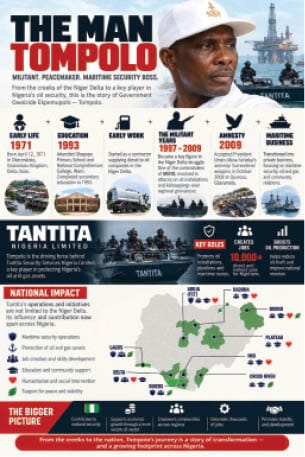
Ekpemupolo was born on April 12, 1971, in Okerenkoko, Gbaramatu Kingdom, in Warri South-West Local Government Area of Delta State.
He spent most of his early years within the riverine environment, a terrain that would later become central to both his militant activities and business career.
He attended Okepopo Primary School in Warri and later the National Comprehensive College, Warri, where he completed his secondary education in 1993. Aside that, not much is known about his education.
He is married to Victoria Ekpemupolo and the union is blessed with children, although only one daughter is known in public domain. Weekend Trust gathered that he has houses in Warri, but mostly lives in Oporoza in Gbaramatu Kingdom, from where he coordinates his businesses.
Aside activism and business, he is also a leader of the Egbesu spiritual tradition. He is often sighted during worship sessions alongside other adherents of the religion. In 2016, a newspaper described him as the chief priest of the Egbesu Shrine in Oporoza. At the time, Tompolo complained that soldiers searching for him had removed what he described as the traditional symbol of authority from the shrine. Till date, he is seen engaging in spiritual activities which are usually publicised on social media platforms.
The name, Tompolo
Weekend Trust gathered that the nickname “Tompolo” is linked to Thomas, his father’s name, while “Polo” was derived from his last name, Ekpemupolo.
Accounts of his early activities have it that he started off as a contractor supplying diesel to oil companies operating in the Niger Delta region.
Weekend Trust learnt that his transition into activism was shaped by the political and communal tensions that engulfed Warri and its surrounding areas in the late 1990s.
Sources said the relocation of the headquarters of a local government area from Ogbe-Ijoh to Ogidigben was one of the issues that intensified tensions between Ijaw and Itsekiri communities at the time.
During that period, he became associated with the Federated Niger Delta Ijaw Communities, an organisation that emerged as part of the Ijaw response to the crisis.
The years between 1997 and 2002 shaped the man who later became popularly known as Tompolo.
He became involved with the Ijaw Youth Council and, subsequently, the armed Niger Delta struggle.
From there, his activities were no longer limited to community agitation. He later emerged as one of the commanders of the Movement for the Emancipation of the Niger Delta, popularly known as (MEND).
MEND’s campaign targeted oil installations and personnel and sought to pressure the federal government and oil companies over grievances concerning the Niger Delta.
The agitation
The violence disrupted oil production and contributed to a period of severe insecurity in the oil-producing region and by extension, affected the economy of the country.
Tompolo’s name became particularly associated with the creeks of Delta State, where the difficult terrain gave militant groups considerable operational advantage.
He was regarded as one of the region’s most prominent militant commanders.
His activities were part of a broader armed campaign that involved attacks on oil infrastructure, kidnappings and disruptions to petroleum production.
The conflict was driven by a mixture of political, economic and environmental grievances, including complaints over the perceived neglect of oil-producing communities and demands for greater participation in the resources extracted from the region.
Sources said his familiarity with the waterways, communities and networks later became an important part of his transition into the oil-security business.
The Amnesty intervention
In 2009, the administration of President Umaru Musa Yar’adua introduced an amnesty programme for militants in the Niger Delta.
Tompolo was among the prominent militant leaders who accepted the offer.
And in October 2009, he surrendered weapons at Oporoza in the Gbaramatu area. There were allegations that rocket launchers, machine guns and explosives were handed over during the ceremony.
The disarmament marked a decisive turning point. The man who was once associated with attacks on oil infrastructure was now drawn into a post-conflict environment in which former militants were expected to abandon armed struggle and participate in the development and economic life of the region.
After the surrender,Tompolo remained an influential figure in the Niger Delta.
From the creeks to maritime business
Following the amnesty, Tompolo became involved in private business, particularly in areas connected with maritime security, oil and gas and community relations.
His familiarity with the Niger Delta waterways became an asset in an environment where oil companies and government agencies faced persistent security and logistics challenges.
One of the most important ventures associated with him at the early stage was Global West Vessel Specialists Limited, Weekend Trust gathered.
In 2011-2012, the company became linked to a major public-private arrangement involving the Nigerian Maritime Administration and Safety Agency. (NIMASA)
It was gathered that the arrangement was such that Global West, his company, would provide platforms, equipment and expertise to assist NIMASA in securing Nigeria’s waterways and improving revenue collection.
A later profile by the Jamestown Foundation described the arrangement as a 10-year, $103.4 million contract involving 20 vessels.
Weekend Trust gathered that the Global West was later subsumed into the Tantita Security Services Nigeria Limited (TSSNL).
The company gained national prominence when in 2022, the Nigerian National Petroleum Company Limited (NNPCL) awarded it an annual pipeline surveillance project reportedly valued at N48 billion.
The contract involved protection of oil pipelines and production facilities in the Niger Delta region.
The NNPCL deal
The NNPCL first awarded the pipeline surveillance contract to TSSNL in August 2022 at N48 billion but was expanded and renewed for three years in 2023.
Tantita operations cover protection and surveillance of oil pipelines in Delta, Ondo, Bayelsa and Rivers, Imo, and parts of Akwa Ibom and Abia States.
Following criticisms, the former Chief Executive Officer of NNPCL, Malam Mele Kyari, defended the contract, saying the government was not dealing directly with the former warlord, but with a company in which Tompolo has interests.
Kyari said though the security agencies were doing their part, the end-to-end pipeline surveillance would require the involvement of private entities and community stakeholders.
He said, “We need private contractors to man the right of way to these pipelines. So, we put up a framework for contractors to come and bid and they were selected through a tender process. And we believe we made the right decision.”
The NNPCL CEO, who said the company had discovered that stolen products were warehoused in churches and mosques with the knowledge of all members of the society where the incidents occurred, added that the entire network of pipelines for petroleum products distribution in the country had been shut down as a result of the activities of vandals.
He said, “As you may also be aware, it is because of the very unfortunate acts of vandals along our major pipelines from Atlas Cove all the way to Ibadan, and all others connecting all the 37 depots that we have across the country. You know, none of them can take delivery of products today.
“And the reason is very simple. For some of the lines, for instance, from Warri to Benin, we haven’t operated that line for 15 years. Every molecule of product that we put gets lost. And of course you remember the sad incident of the fire incident very close to Warri, close to Sapele that killed so many people.
“So, we had to shut it down and as we speak, ladies and gentlemen, the level of losses that we have on our product pipeline, and I’m sure you may have seen it and I’ll invite you at the right time so we can take a look at it jointly.
“You remember that Lagos area. When a fire outbreak happened in one of our pipelines, we discovered that some of the pipelines were actually connected to individuals homes. And not only that, and with all sensitivity to our religious beliefs, you know, some of the pipelines and some of the products that we found, are actually in churches and in mosques.
“That means that everybody is involved. There is no way you will take products, bring in trucks in populated neighborhoods, load it and leave without everybody else knowing about it. That everybody includes members of the community, members of the religious leadership and also and most likely government officials of all natures, including security agencies personnel. They are everywhere. And I’ve seen this even in the Niger Delta. There’s no way you would deliver a volume and lose up to 30 percent and you will continue to put that product in this line.”
Efforts by Weekend Trust to get fresh perspectives on the contract from the NNPCL, proved abortive. However, a source in the corporation who spoke on condition of anonymity, said the contract to Tompolo, was “yielding results”.
“The contract has helped us to increase oil production and reduce theft. Those areas are very hard to reach. Only people with good knowledge of the the area can protect our oil facilities”, he said.
Also, a former Delta State governor, Ifeanyi Okowa, while commending the government for awarding the contract to Tompolo’s firm, said it indicated that the government listened to him on how to review oil facilities surveillance contracts and integrate oil-bearing communities to check rising cases of oil theft, an idea he claimed he suggested when a federal government delegation on oil-theft issues visited him in Asaba.
He said the state was happy to hear that just a few days after the visit, the federal government listened to his advice and awarded the surveillance contract to Tompolo.
He noted that giving jobs to people from the Niger Delta region would give them a sense of belonging and help to curtail the rising incidence of oil theft with its attendant effect on the nation’s economy.
Okowa said it was time host communities, “which suffer severe impacts of oil exploration and exploitation in the region”, were considered partners in the oil production process.
It would be recalled that in December 2022, a delegation of House of Representatives members visited oil-producing areas and met Tompolo, as part of an oversight exercise.
The lawmakers said they had observed improvements in the security of oil infrastructure and a reduction in attacks.
Peter Akpatason, who led the delegation, said the partnership involving Tantita, NNPCL and other security agencies had produced “significant improvement” in the country’s ability to produce hydrocarbons. He nevertheless said Tantita needed to do more.
Tompolo on his role
Tompolo said his current activities were part of a broader effort to protect the Niger Delta and Nigeria’s oil economy.
In his remarks following a recognition by the Nigeria Union of Journalists (NUJ) for internal security contributions, said oil and gas remained central to Nigeria’s economy and argued that people from the Niger Delta should participate in the business surrounding the resources extracted from the region.
“We want to be part of the business,” he said, while arguing that “Niger Delta communities should not simply watch others come into the region, take its resources and leave”.
He also pledged to work with his team to increase oil production and tackle crude oil theft.
“I will do anything within my power and with my team to ensure that oil production increases for the country to have funds to grow the economy,” he said.
He further said he wanted to see an end to crude oil theft in the region.
“I want to assure Nigerians that we will put an end to the menace of crude oil theft in this region… I don’t have any other country to call my own except Nigeria,” he said.
Experts speak on contract
Speaking with Weekend Trust, a Lagos-based oil and gas analyst, Jamiu Idris, said to appreciate the contract, one must recall the state of near-collapse that defined Nigeria’s oil industry just a few years ago.
“Before the implementation of the Tantita Security Services Nigeria Limited (TSSNL) framework in late 2022, the nation faced an existential threat. Oil production had cratered to a historic low of 1.015 million barrels per day (bpd) in September 2022-a staggering decline that jeopardised the federal budget, weakened the naira, and pushed the economy toward the brink of insolvency,” he stated.
Also, industry analyst, Nse Victor Udoh, said effective pipeline protection had helped the country move away from crisis management towards longer-term planning.
“It is important to clarify the role of pipeline surveillance within the wider energy landscape. Energy security encompasses the full value chain, from exploration and production to refining, distribution, pricing policy, and subsidy frameworks.”
He stressed that pipeline surveillance has a specific but critical function: protecting infrastructure used to transport petroleum resources.
“Yet this single function has proven foundational. Without secure transportation channels, production targets falter, refining plans collapse, exports decline, and fiscal projections become unreliable,” he said.
According to Udoh, the security of oil infrastructure should, therefore, be regarded as an economic priority rather than merely a security operation.
“Asset protection, in this context, is not a supporting activity. It is a precondition for economic order,” he said, adding, “In effect, the pipeline is the hinge on which the entire petroleum value chain turns.”
He said sustained monitoring and rapid response systems had reduced pipeline breaches and illegal tapping, improving the reliability of crude flows.
‘Private firms should not protect public infrastructure’
The Executive Director of a Civil Society Organisation, Centre for Fiscal Transparency and Integrity, Umar Yakubu, faulted the engagement of private companies to protect public infrastructure, describing the practice as unsustainable and a poor use of public resources.
Yakubu, who spoke on the issue, said the responsibility for protecting critical public infrastructure already falls within the mandate of government security agencies, particularly the Nigeria Police Force and the Nigeria Security and Civil Defence Corps (NSCDC).
“As a civil society, I’ll first tell you it is improper to give a private company the responsibility to protect public infrastructure. It is hardly done anywhere,” he said.
He said the government already had security institutions specifically established and funded to protect public assets, questioning the rationale for committing additional public funds to private security companies.
“You have the Nigerian Police that has a responsibility to protect public infrastructure, but specifically, you have the Nigerian Security and Civil Defence Corps that receives billions of Naira every year from public funds to protect public infrastructure,” Yakubu said.
“After these two law enforcement organisations, why would you still pay billions of naira to some private companies, whether it’s one or two or three, to protect public infrastructure?” he asked.
According to him, the practice was not only financially unsustainable but also raised questions about governance and the effective use of public resources.
“The country cannot sustain payment of private companies to protect public infrastructure. It doesn’t make economic or governance sense,” he said.
Yakubu said the debate should not be limited to the number of private companies engaged by the government but should address the broader policy of outsourcing the protection of public infrastructure.
“I think we have to look at it holistically because this is a culture, a habit, that we shouldn’t have and is not sustainable,” he said.
His philanthropy
In 2012, the Tompolo Foundation spent about N20 million on the renovation of the Okerenkoko Cottage Hospital in Warri South-West Local Government Area of Delta State. During the 2012 floods, it donated N150 million worth of relief materials to flood victims in Bayelsa, Delta and Rivers states.
And in 2014, it was reported that the foundation spent N50 million on educational materials to 15 primary schools and five secondary schools in Warri South-West area. The materials included books, sandals, shoes and instructional materials.
In January 2023, Tompolo donated 458 single-seater desks worth N30 million to the Nigeria Maritime University, Okerenkoko, Delta State. The donation was made during the university’s combined matriculation ceremony. The biggest publicly documented donation came in October 2025, when Tompolo through Tantita Security Services Nigeria Limited pledged N10 billion to the Delta State Security Trust Fund during its launch at the Government House in Asaba in 2025.
The foundation has also been linked to healthcare interventions in communities including Okerenkoko, Ogulagha, Warri, Ekpan, Ogbe-Ijo, Ugbokodo, Yenezeugene, Abonema and Patani.
A former President of Ijaw Youths Council (IYC) Worldwide, Engr. Udengs Eradiri, in one of his press releases stated that Tantita had provided jobs for thousands of stakeholders mainly youths across all the nine states of the Niger Delta, adding that the company had empowered many people with decent lifestyles.
He said for some years, traveling along major roads in the Niger Delta region, especially the East-West Road had remained peaceful, attributing the development to the engagement of the youths by Tantita.
He said: “Tantita Security Service that is providing security for oil gas infrastructure in the Niger Delta is one of the positive things that President Bola Tinubu administration has sustained. It came about from the conflict that led to the decline of oil production in the region and the government wanted a permanent solution to the problem. The Ijaw youths council and the agitators in the region had constantly talked about participating in the activities of the region.
“The government decided to hand it over to the people of the region. But you must deal with somebody and Tompolo displayed the discipline and the organisation to be able to transact with the federal government and that is what I think the federal government did at the time and it had seen oil production go up and restored investor confidence. Many foreign investments are coming into the Niger Delta and it is already creating a lot of engagements and jobs for our people. In fact in Bayelsa, in Rivers, Imo, Edo, Ondo, Akwa Ibom, Abia, many young people are involved in the company’s operations. Many of them are living a decent life because of what Tompolo is doing. Many people will take this job, keep the money to themselves and become lords in the region”, he said.
From regional influence to national political mobilisation
After maintaining a relatively low profile, one confined to the Niger Delta region for a long time, ahead of the 2027 elections, Tompolo appears to have shelved his shell, extending himself to other parts of the country.
Some months ago, the PBAT Door-to-Door Movement associated with him began expanding its structures beyond the Niger Delta, mobilising support for President Tinubu ahead of the 2027 presidential election.
The movement’s activities have included the distribution of campaign vehicles and the establishment of grassroots structures.
Tompolo, under the Tinubu/PBAT Door-to-Door Movement, held an event in the Federal Capital Territory, recently to drum support for President Tinubu’s re-election. The event had in attendance major traditional rulers and stakeholders from the Niger Delta region and beyond. After that, there were reports that billboards of the president adorning major streets in the FCT were sponsored by him. Weekend Trust could not independently verify this.
Tompolo has also made inroad into the northern region with donations to support campaigns for the re-election of President Tinubu. Reports have it that he donated 50 branded vehicles which were presented to the Kano State government on September 27, 2026, under the Tinubu/PBAT Door-to-Door Movement.
Each of the vehicles was fitted with a new generator and public-address system. The vehicles, Opel Zafira wagons, were manufactured between 2004 and 2006, and were branded.
Checks indicate that the current market value of a fairly used Opel Zafira vehicle of the specified models in Nigeria ranges between 3.5 million and 7.5 million per unit, depending on the condition of the vehicle.
For foreign-used, the estimated prices range between 5 million and 8.4 million, depending on factors including customs clearance, engine condition and mileage.
Based on the estimated prices, the 50 vehicles could be worth between 175 million and 375 million if valued as fairly used vehicles.
And if valued at the prevailing prices for Tokunbo vehicles, the total could range between 250 million and 420 million.
The vehicles were additionally equipped with brand-new generators, each estimated to cost up to 400,000, and speakers valued at approximately 640,000 each.
Representing Tompolo at the donation in Kano State, the Speaker of the Delta State House of Assembly, Emomotimi Guwor, said the Movement would take its campaign directly to voters through structures established at the grassroots.
“The plan is that every door will be knocked, every home will be knocked, so that people will give their massive support to the president,” Guwor said.
He added that the Movement would establish structures across the country and deploy coordinators at the ward and polling-unit levels to engage residents ahead of the election.
Also, 34 vehicles were donated to the Tinubu support group in Katsina State, to be distributed across each of the 34 local government areas of the state. Each of the vehicles; Opel Wagon, came with a generator and a sound system.
Weekend Trust gathered that they were presented to Governor Dikko Radda for onward distribution to campaign coordinators in the local government areas. It was also gathered that another 30 vehicles were donated in Sokoto.
Weekend Trust further gathered that 88 speakers, 44 generators, 44 amplifiers and 44 microphones were donated for the same purpose in Borno State. It was reported that 44 (Opel Zafira) vehicles to the state.
Tompolo, who was represented at the event by Kestin Pondi, Managing Director of Tantita Limited, urged the people of Borno State to back the re-election bid of President Tinubu. A car dealer in Maiduguri, Alhaji Muhammad Hussaini, said they normally buy Opel Zafira from importers at the cost of N5.2 million ad sell at N5.5 million.
“Roughly, the 44 Opel Zafira would cost around N240m”, he said.
Furthermore, Weekend Trust gathered that Tompolo under the same initiative donated 50 Sharon buses across the 13 local government areas of Nasarawa State to support grassroots mobilisation for President Bola Tinubu ahead of the 2027 general elections.
The Movement said the buses will support its door-door and ward to ward campaign for the president. A car dealer put the second-hand value of the car at N6.5m for each and the cost of a brand new one at between N10m and 14m.
Yesterday, October 2, the Movement donated 40 Opel Zafira to Yobe State for the re-election of President Tinubu. A car dealer put the cost at between N5.2m and N5.5m for each.
Efforts to get the man at the centre to speak on his motivation for his recent actions proved abortive, but sources close to him who do not want to be mentioned said, Tompolo has grown beyond one region and it was “time to play on the national stage”.
What You Should Know
This story explores the life and influence of Government Oweizide Ekpemupolo, popularly known as Tompolo, mapping his journey from leading militant groups in the Niger Delta creeks to commanding massive maritime security contracts and wielding political influence nationally.
- Potential Positive Impact: Stronger collaboration between federal authorities and regional stakeholders can enhance maritime security, curb oil bunkering, and stabilize petroleum production.
- Potential Concerns: The concentration of security influence and economic power in the hands of former militant leaders raises long-term governance questions and challenges regarding state monopoly on security.